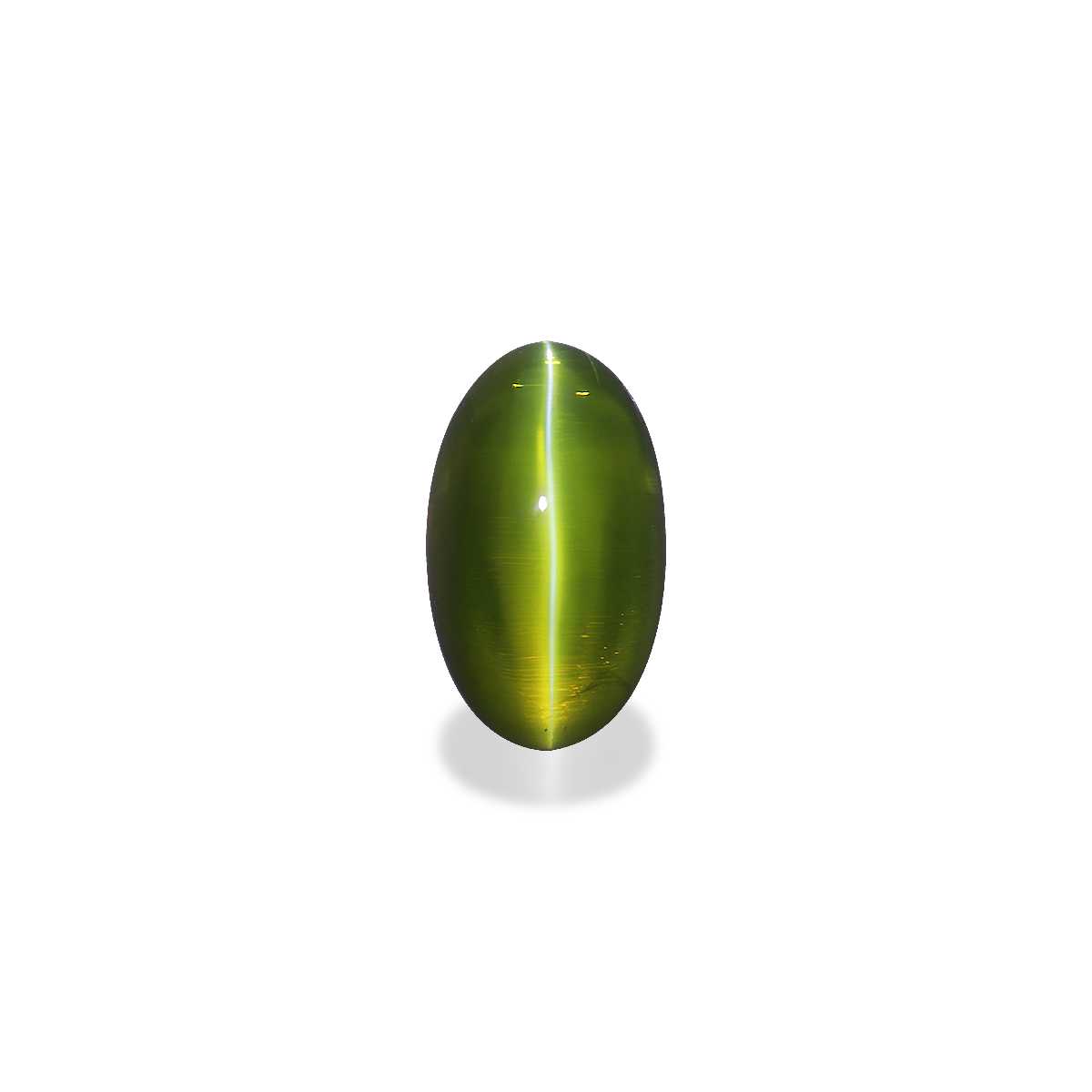
This page gathers the stones in our collection that display chatoyancy — the single bright band of light, reminiscent of a cat's pupil, that glides across the dome as the gem is rocked beneath a light source. The effect arises from countless fine, parallel needle-like inclusions or growth tubes within the crystal, which reflect light back as one concentrated line rather than scattering it. Because the phenomenon depends entirely on orientation, such gems are cut as cabochons, with the base aligned so the eye stands perpendicular to the needles and rises at the centre of the dome.
Two varieties carry the trade name here: chrysoberyl, the classical cat's eye and the only gem permitted the unqualified name in gemmological usage, and alexandrite, the colour-change variety of chrysoberyl, where chatoyancy and a shift in hue between daylight and incandescent light may be seen together.
When comparing pieces, weigh the sharpness and straightness of the eye, how well it is centred, how cleanly it opens and closes as the stone moves, and the body colour. A high dome usually gives a crisper eye; a flatter one shows more of the body colour.