Moss Agate Jewelry: Care and Durability
Moss agate jewelry is durable enough for regular wear but not indestructible: the stone is a cryptocrystalline quartz with a Mohs hardness of roughly 6.5 to 7 and good toughness, since it has no cleavage planes to split along. It resists everyday knocks far better than opal or emerald, yet it abrades slowly against household dust and will lose its polish over years on a ring worn daily. Clean it in warm water with mild soap and a soft brush, keep it away from ultrasonic machines, steam, bleach and acids, and choose a bezel or low-profile setting that shields the girdle and any thin edges.
Hardness and toughness explained
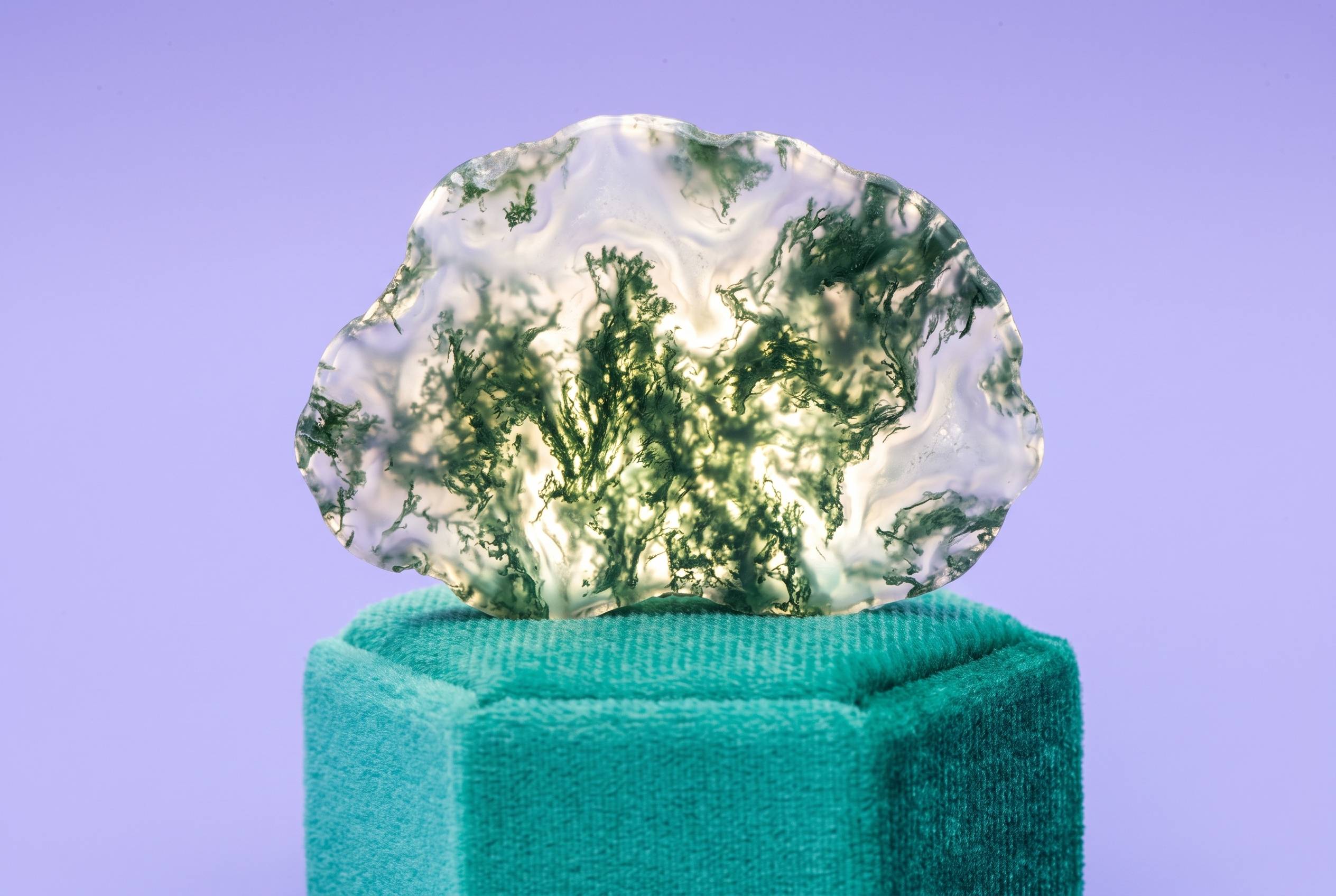
Moss agate is chalcedony — quartz in a microscopically fibrous, intergrown form. Its refractive index sits around 1.53 to 1.54 and its specific gravity around 2.57 to 2.64, and like all quartz it belongs to the trigonal system.
That fibrous structure matters more than the hardness number. Interlocking fibres give chalcedony better toughness than single-crystal quartz such as amethyst, which means it tolerates impact without splitting cleanly.
The green "moss" is not organic material. It is a scatter of mineral inclusions — commonly chlorite, hornblende or iron and manganese oxides — suspended in the colourless to milky chalcedony host. Some of those inclusions are softer than the quartz around them, which has consequences during cutting and polishing.
Everyday wear for moss agate jewelry
A hardness of 6.5 to 7 places moss agate at roughly the same level as the quartz dust that makes up a large share of ordinary household grit. Over years, that dust is what dulls a cabochon's surface — not dramatic accidents.
Earrings, pendants and brooches face almost no risk. Rings and bracelets take the abuse, and a moss agate ring worn through gardening, gym sessions and kitchen work will show micro-scratches on the dome long before it ever chips.
The genuine hazards are sharp impacts against stone, tile or steel, and thin freeform slices set with unsupported edges. Thickness and edge protection decide whether a piece survives a decade of wear.
Remove rings before manual work, sport, swimming and heavy cleaning. That single habit does more for longevity than any product you can buy.
Cleaning do's and don'ts
Moss agate is stable in water and tolerant of gentle handling, so routine cleaning is simple. The risk comes from machines and chemicals, not from washing.
Safe practice
- Lukewarm water with a drop of mild dish soap.
- A soft baby toothbrush around the setting and under the stone.
- Rinse in clean water and dry with a lint-free cloth.
- Check prongs and bezel edges each time you clean.
What to avoid
- Ultrasonic cleaners — vibration can propagate surface-reaching fractures and loosen inclusion-rich zones.
- Steam cleaners — thermal shock is the main cause of crazing in chalcedony.
- Bleach, ammonia, drain cleaner and acids — these attack dyes and can etch the polish on some material.
- Silver dip solutions — never submerge a set stone.
- Abrasive pastes and toothpaste — they scratch a polished dome.
- Sudden temperature change — no hot taps straight after cold water.
Agate is one of the most commonly dyed gem materials in the trade, so treat colour as a question rather than an assumption. Genuine moss agate owes its green to mineral inclusions, but dyed green chalcedony is occasionally sold under the name, and dye is vulnerable to solvents and prolonged sunlight.
Settings that protect the stone
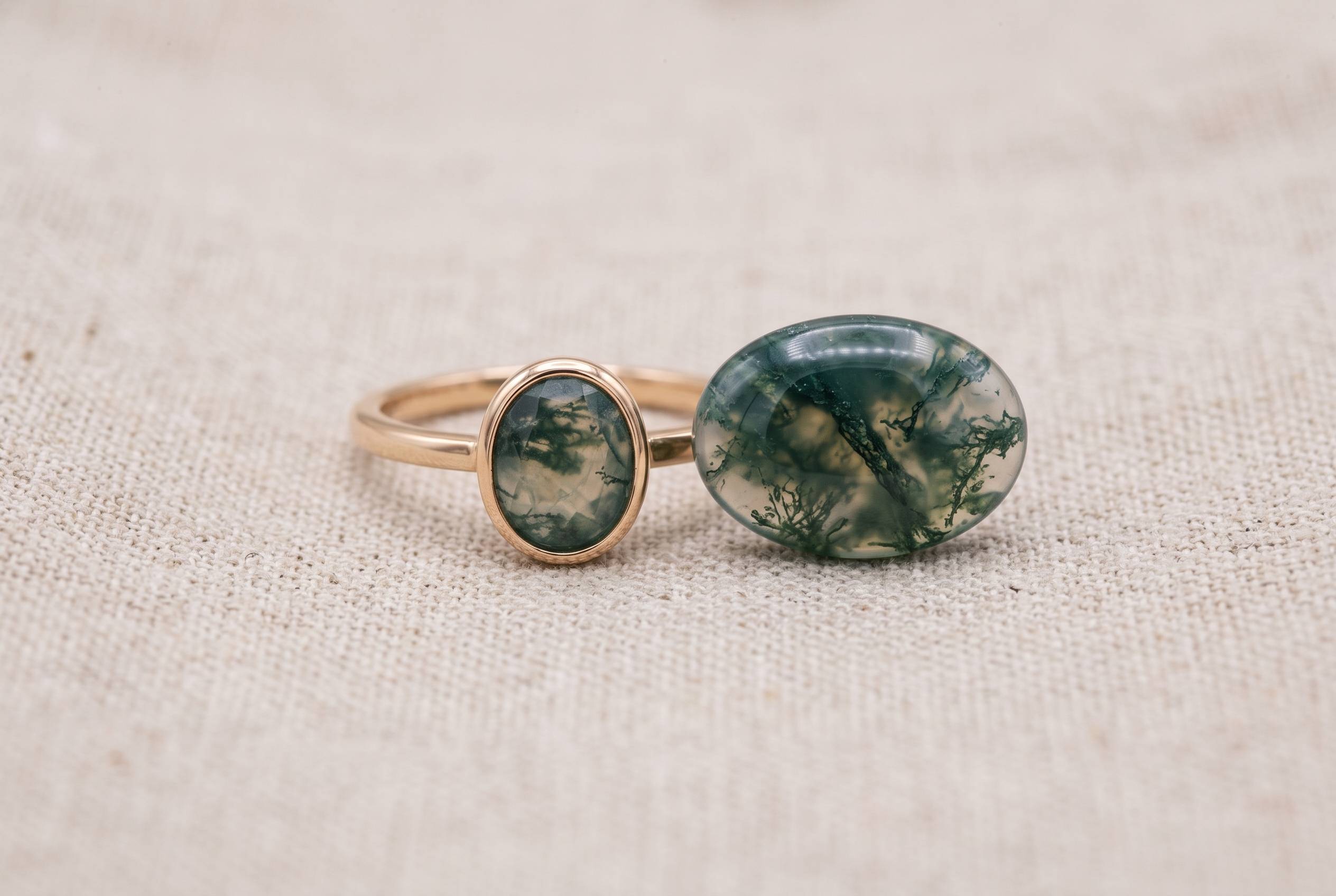
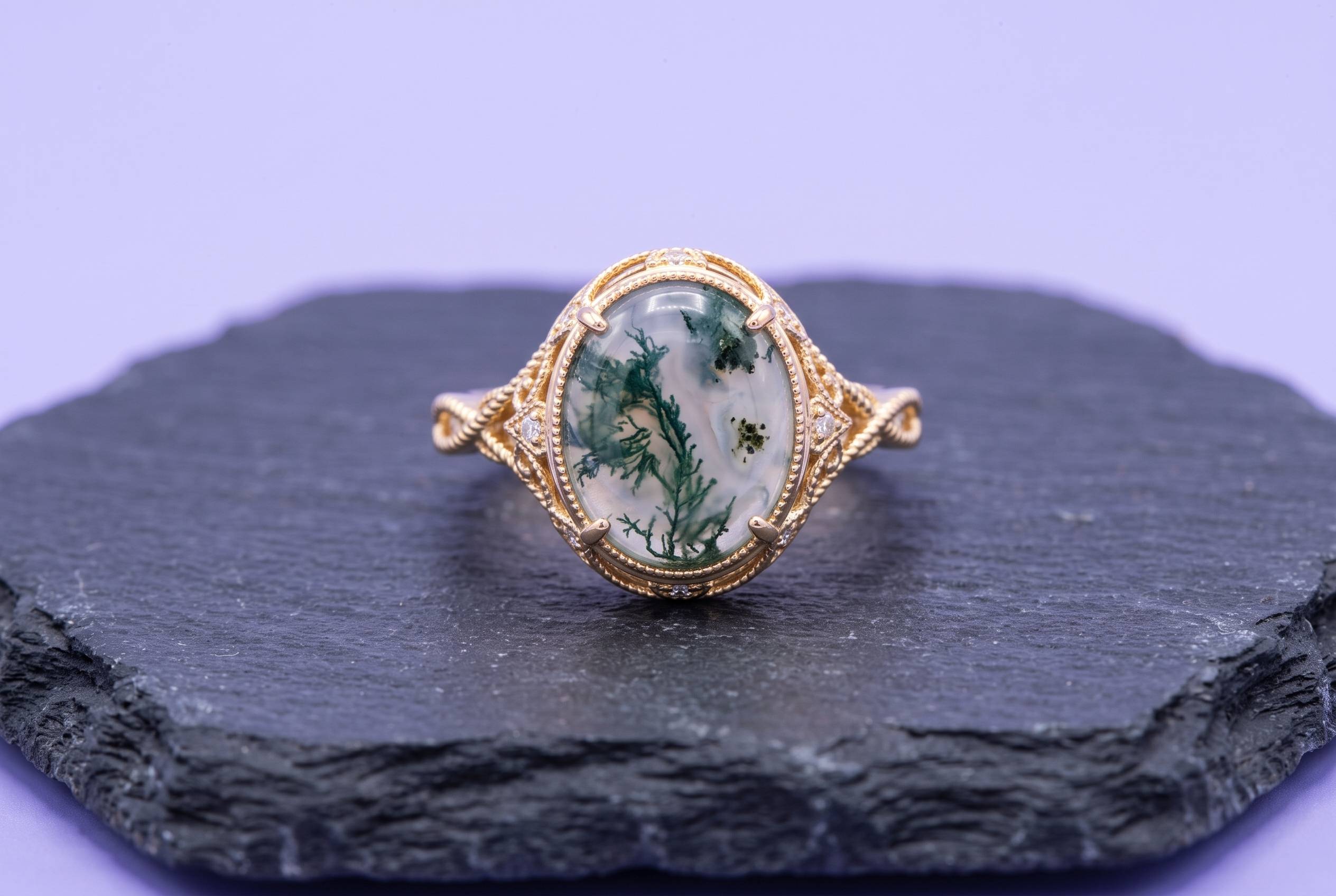
Moss agate is almost always cut as a cabochon, a flat tablet or an organic slice, and each form wants a different kind of protection. A full bezel is the strongest option: it covers the vulnerable girdle completely and distributes pressure evenly around the perimeter.
For slices and thin tablets, insist on a bezel with a supporting back plate or a substantial gallery. An unsupported slice held by four thin claws is the single most common failure in nature-inspired designs.
If you prefer prongs, ask for rounded, broad tips that sit over the shoulder of the dome rather than sharp claws biting into the surface. Four to six prongs on a cabochon is sensible; fewer concentrates stress.
Low profile beats high profile on any ring. A stone that sits close to the finger catches on doorframes and car doors far less often than a raised setting.
Avoid tension settings entirely. They rely on compressive force that chalcedony is not well suited to bear.
Storage, repair and resizing
Store each piece separately in a soft pouch or lined compartment. Sapphire, topaz, spinel and diamond will all scratch moss agate in a shared jewellery box.
Before any workshop repair, tell your jeweller the stone must come out first. Torch heat for sizing or soldering can craze chalcedony, and some fracture-filled or dyed material reacts badly to pickle solutions and plating baths.
If a bezel lifts or a prong wears thin, deal with it immediately. Most lost stones were loose for weeks beforehand, and a yearly inspection catches nearly all of it.
Buying with longevity in mind
Durability is designed in at the bench, so examine the stone before it is set wherever possible. Hold the cabochon to a strong light and look for surface-reaching fractures, which appear as bright lines breaking the outline.
Run a fingertip over the polished dome. Slight pitting or undercutting usually means softer chlorite inclusions plucked out during polishing, and those hollows collect dirt and catch on fabric.
Ask directly whether the material has been dyed or stabilised. Fine untreated moss agate is widely available, so there is rarely a reason to accept treated goods, and a seller who cannot answer plainly is answering plainly enough.
For descriptions of chalcedony's physical properties, standard gemmological references such as the GIA gem encyclopedia and Webster's Gems remain the sensible benchmarks.
Treated as a stone of moderate hardness and good toughness — bezel-set, kept off the hand during rough work, washed in soapy water rather than a machine — moss agate will look much the same in twenty years as it does today. Its value as a gem lies in a landscape that cannot be repeated, and protecting that is simply a matter of sensible habits.
Frequently asked questions
Can moss agate jewelry be worn every day?+
Yes, with sensible care. At 6.5 to 7 on the Mohs scale with good toughness, moss agate handles daily wear in earrings and pendants easily, and in rings provided you remove them for sport, gardening and heavy cleaning. Expect a daily-worn cabochon to need repolishing after some years.
Can I clean moss agate in an ultrasonic cleaner?+
No. Ultrasonic vibration can extend surface-reaching fractures and dislodge inclusion-rich zones, and steam cleaners risk thermal shock. Warm water, mild soap and a soft brush are the safe method.
Does moss agate fade in sunlight?+
Natural moss agate, coloured by mineral inclusions such as chlorite and iron oxides, is stable in light. Dyed chalcedony sold under the moss agate name can fade with prolonged UV exposure, which is one reason to confirm the stone is untreated.
What is the best setting for a moss agate ring?+
A full bezel in a low-profile mount gives the best protection, since it shields the girdle and spreads pressure evenly. For thin slices, ask for a bezel with a supporting back plate rather than thin claws, and avoid tension settings entirely.
Can moss agate get wet?+
Yes. Chalcedony is not porous in the way turquoise or opal can be, so washing and rinsing are harmless. Avoid chlorinated pools, hot tubs and household chemicals, which attack dyes and can damage the polish and the metalwork.
Will moss agate scratch?+
Over time, yes. Household dust contains quartz of similar hardness, so a polished dome gradually dulls with contact. The scratching is cosmetic and a lapidary can repolish most cabochons without significant loss of material.
From our Journal
Buying guides, origin stories, and notes from the trade.