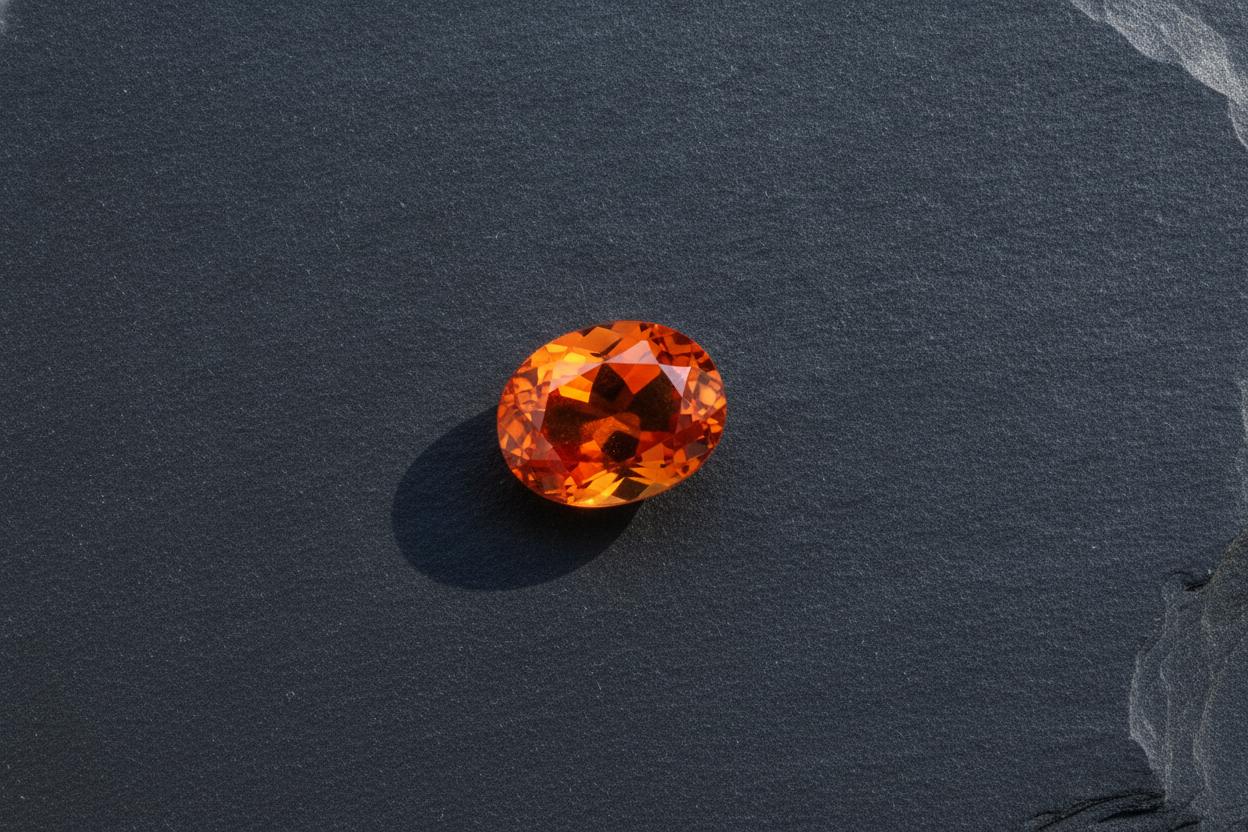
Spessartite Garnet Meaning and Symbolism
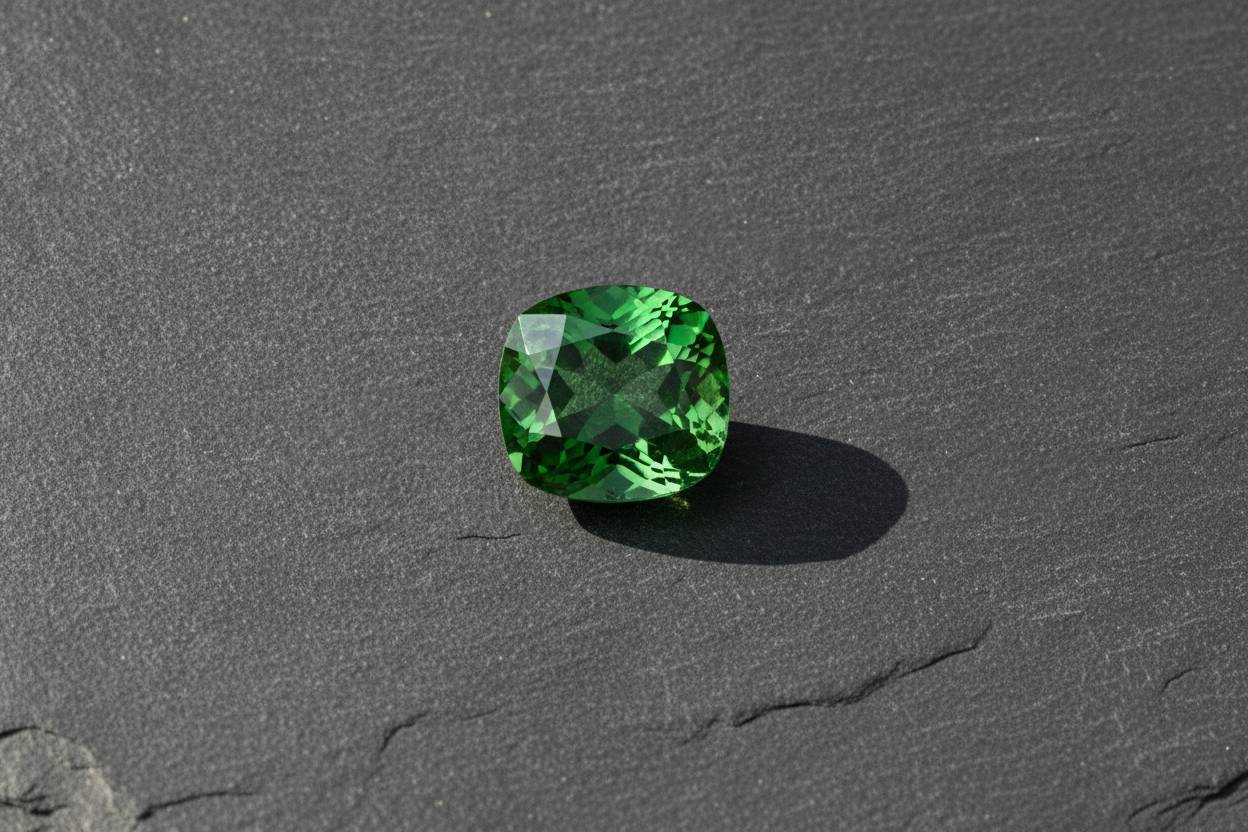
Spessartite garnet meaning and symbolism revolve around vitality, courage and decisive action — a reading taken directly from the stone's manganese-fed orange, the most saturated in the garnet family. Garnets have long been carried as talismans of safe return and steady energy, and spessartite inherited that role in a warmer, more outward-facing key. For buyers the symbolism and the money are linked: the very colour intensity that gives the stone its character is also the largest single driver of price per carat, followed by clarity, size and origin.
Understanding that link is the practical part. A stone whose orange is dull or brownish carries neither the visual message nor the value of a clean, vivid one.
Spessartite garnet meaning and symbolism
The variety takes its name from the Spessart district in Bavaria, where it was first described. The broader garnet group name comes from the Latin granatum, pomegranate, after the seed-like red crystals that gave the family its identity long before orange material reached the market.
Traditional garnet lore emphasised protection on journeys, constancy and the maintenance of energy. Spessartite, arriving in quantity only in the modern era, absorbed that inheritance and attracted its own associations: creativity, confidence, warmth and the willingness to begin something.
None of this is gemmology, and we do not present it as such. It is simply the cultural layer that explains why a stone the colour of a low sun has been read the way it has.
Why manganese drives the price
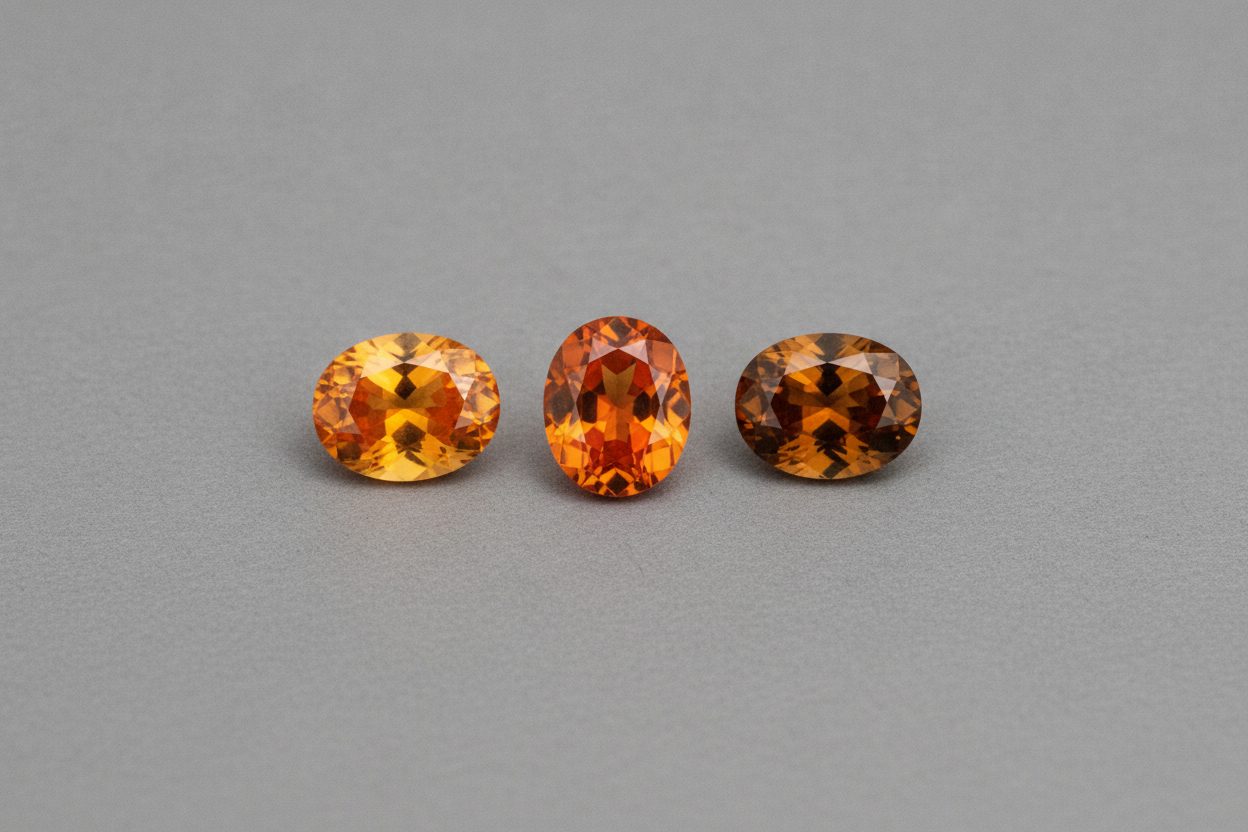
Spessartite owes its colour to manganese, an essential constituent of the mineral rather than a trace impurity. That is why the orange can reach a purity no other garnet achieves without help.
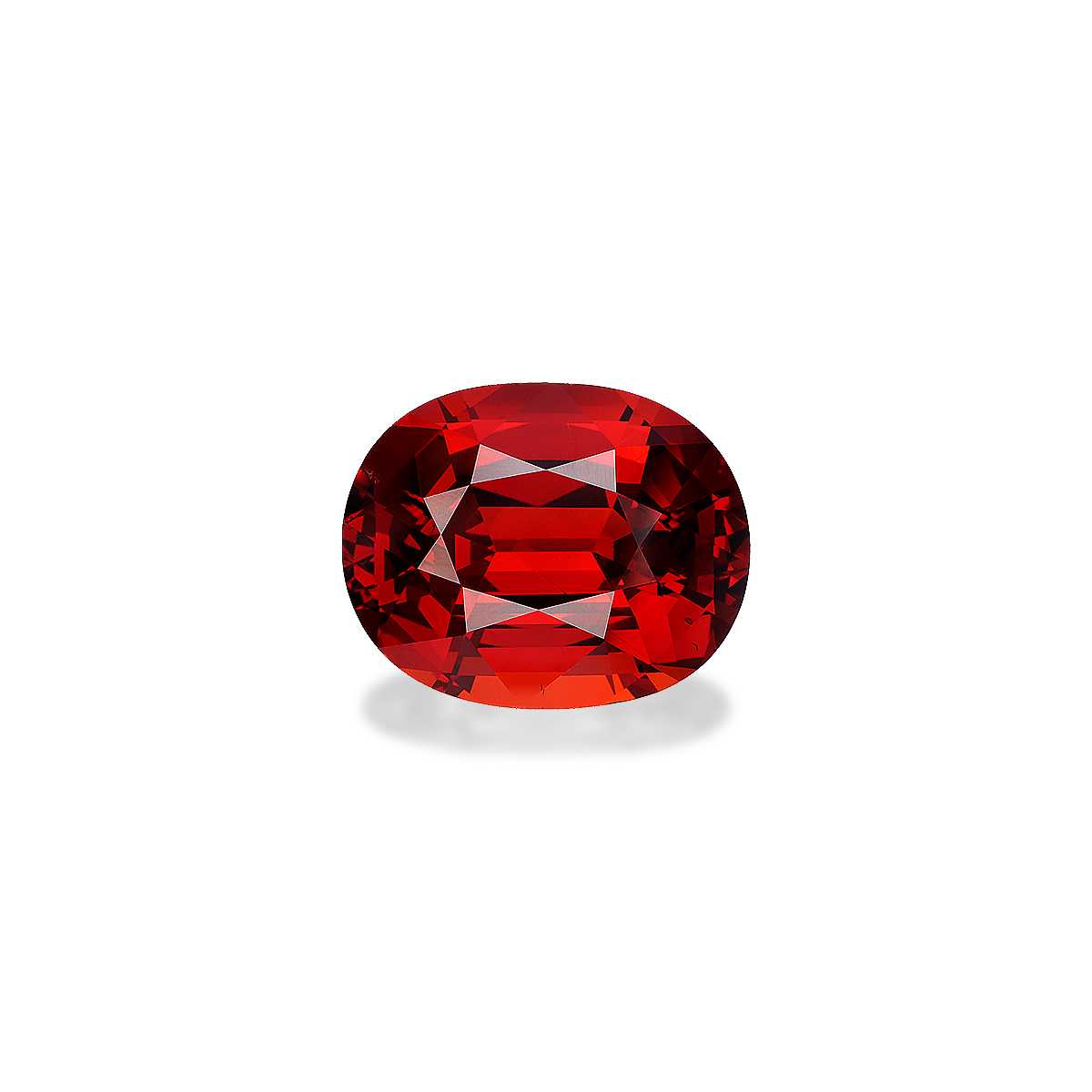
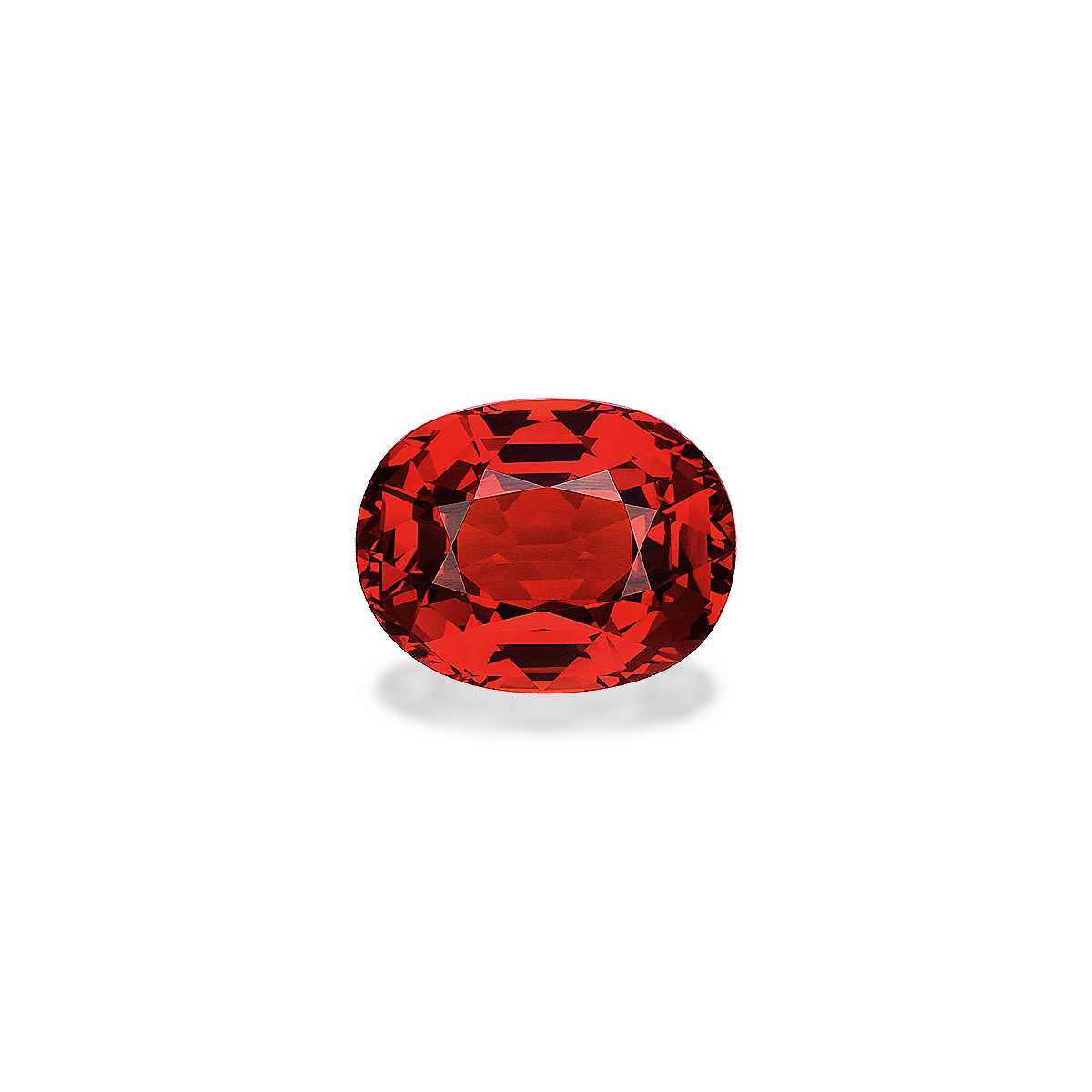
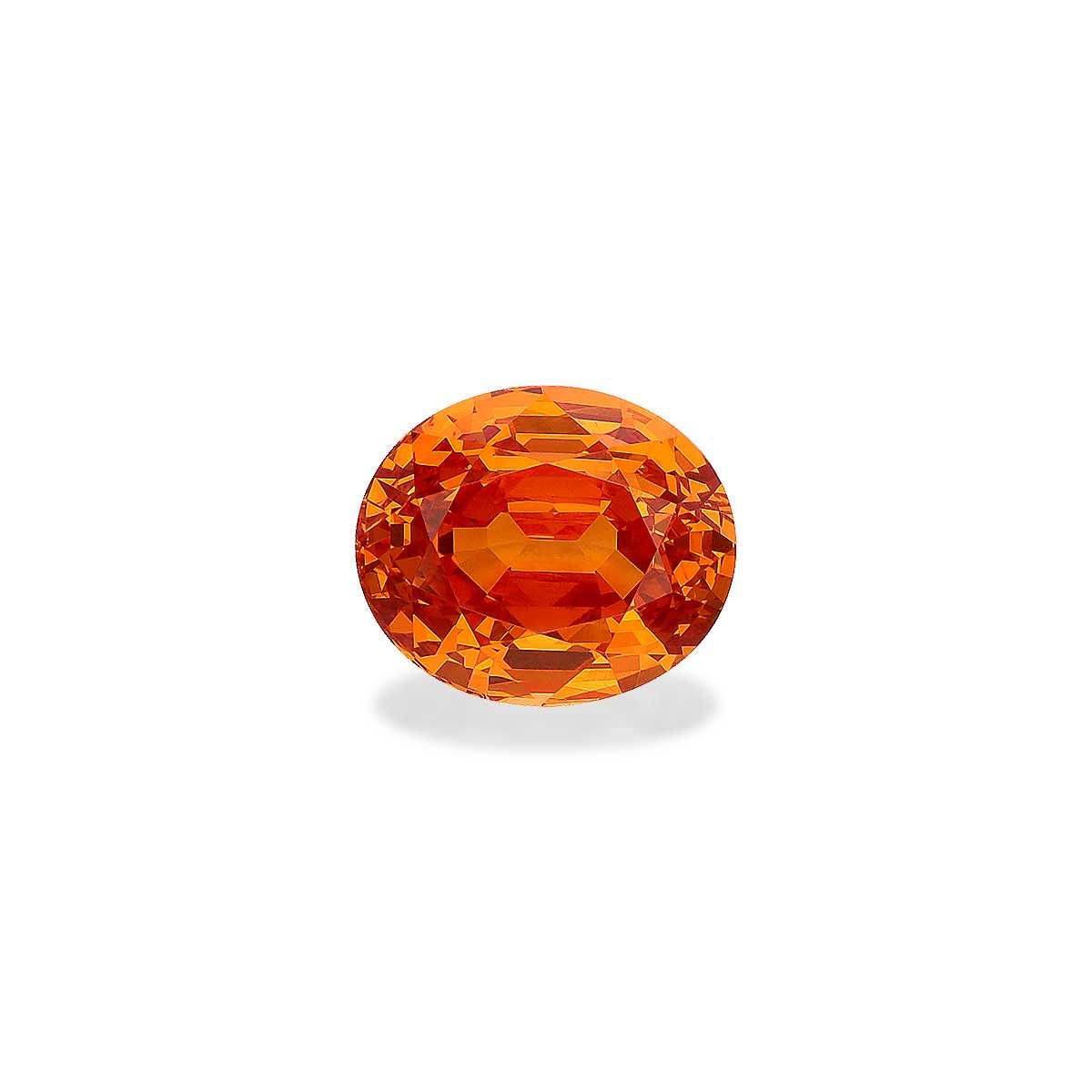
The market sorts this colour into recognisable steps. The trade terms Fanta and Vivid describe the top of that ladder: a bright, slightly reddish to pure orange with high saturation and no grey or brown masking it.
Below that sit stones with brownish modifiers, lower saturation, or a tone pushed dark enough to swallow light. The drop in price per carat between a vivid orange and a muted one is steep, and it is steeper than most buyers expect from a photograph.
Reading colour honestly
- Judge the stone face-up in daylight or neutral light, never under warm retail spotlights that flatter orange.
- Check for colour zoning — uneven patches of stronger and weaker orange, common in this material.
- Look for a window: a pale centre where light passes straight through indicates a shallow cut and costs real money in apparent colour.
Clarity in a manganese garnet
Spessartite is a type II clarity stone in practical terms: inclusions are normal and expected. The typical content is tiny crystals, feathery inclusions and the colour zoning already mentioned.
Fine material can still be eye-clean, and eye-clean commands a clear premium in the better colour grades. Heavy feathering that disturbs brilliance, or clouds that make the stone look sleepy, pulls the price down quickly.
The refractive index of 1.78 to 1.80 is high, which is why a well-cut spessartite returns light so forcefully. That same brightness exposes inclusions, so cutting and clarity should be assessed together rather than separately.
More from Spessartite Garnet


Size tiers and real scarcity
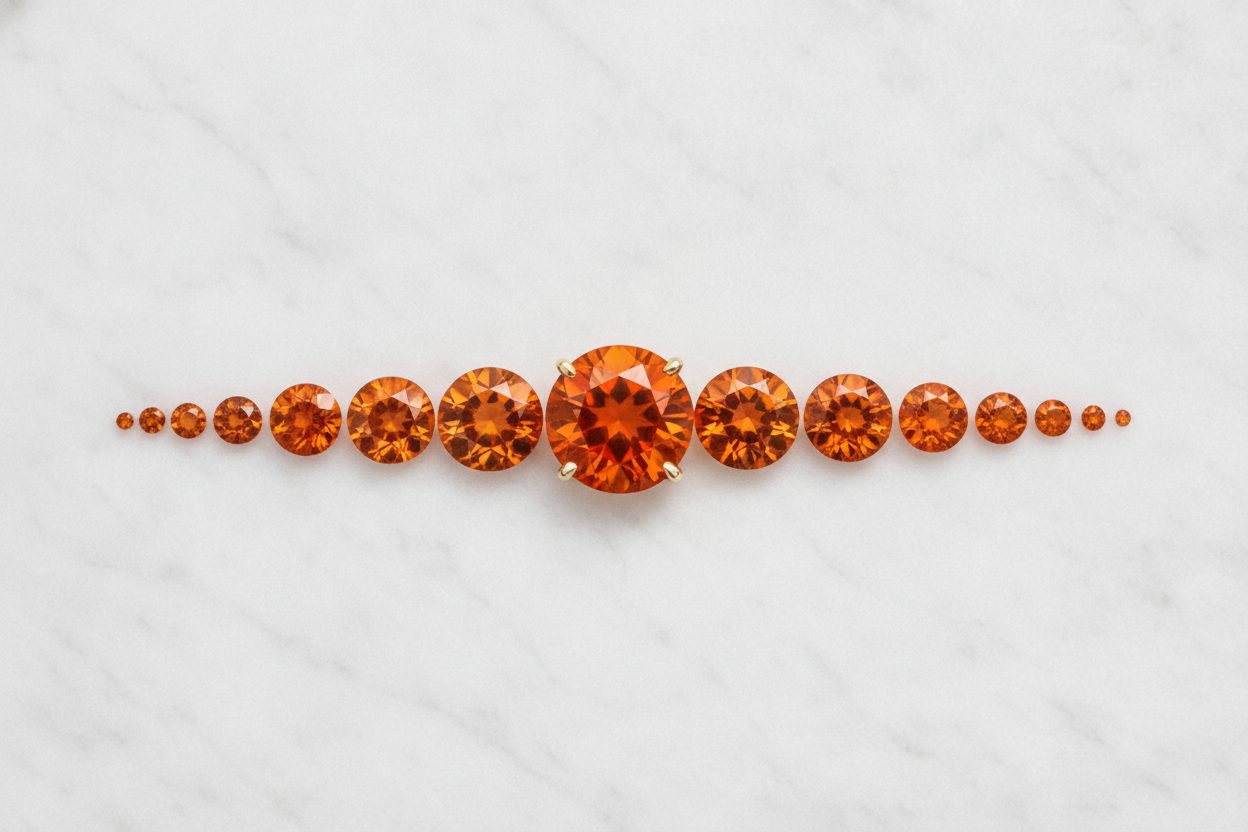
Clean, vivid spessartite is readily available in small calibrated sizes and becomes progressively harder to find as weight increases. The scarcity is not gradual — it steps.
Melee and small accent sizes trade as a commodity. Once a stone is large enough to be a convincing centre, and still holds vivid colour without brown, the pool of candidates narrows sharply and price per carat rises rather than scaling evenly.
In large sizes the problem compounds: deeper material absorbs more light, so a big stone must be cut with care to avoid going dark. Large, bright, clean examples are genuinely scarce and priced accordingly.
Origin and the unheated question
Commercially important spessartite comes from several parts of Africa, with Nigeria and Namibia among the best-known sources, and from Burma. It is wrong to assume a single country of origin for all spessartite on the market — that assumption has been used to justify prices and stories that do not hold up.
Origin influences value mainly through typical colour and clarity rather than through name alone. Nigerian material built the modern reputation for bright, fanta-toned orange; Namibian stones are prized for purity of hue; Burmese material appears in smaller quantity.
On treatment, the position is straightforward: spessartite garnet is sold unheated. It is not a stone that relies on enhancement for its colour, and buyers should not assume otherwise or accept a discount framed around a treatment that was never applied.
Fair price and common traps
A fair range is best understood as a grid rather than a single figure. Colour intensity sets the tier, clarity and cut decide where the stone sits within it, and size multiplies the result.
Three mistakes account for most of the money lost in this material:
- Overpaying for low-quality stones. Brownish, windowed or heavily included spessartite is abundant; it should be priced as abundant material, not as fine goods.
- Confusing it with other garnet varieties. Hessonite, malaya and mixed almandine–spessartite stones can look similar in photographs but sit in different price brackets. Ask for the variety in writing.
- Assuming the stone has been heated. It has not, and no seller should be arguing value either up or down on that basis.
For a stone of consequence, ask for a report from an independent laboratory — GIA, SSEF, Gübelin or GRS among them — confirming the variety and the absence of treatment. For modest sizes, a reputable dealer's written description is usually proportionate.
Spessartite Garnet price guide
Spessartite Garnet price guide (per carat, USD)
Based on 242 spessartite garnet in stock, updated October 19, 2026.
At 7.5 on the Mohs scale, spessartite is durable enough for rings worn regularly, provided it is set with a little protection at the girdle. Buy the colour first, insist the clarity supports it, and the symbolism takes care of itself — a stone that genuinely glows is the only version of this gem worth owning.
Frequently asked questions
What does spessartite garnet symbolise?+
Spessartite is traditionally associated with vitality, courage, creativity and safe return, inheriting the protective symbolism attached to garnets generally. Its warm manganese orange has also linked it to confidence and renewed energy. These are cultural associations rather than gemmological properties.
What is fire orange spessartite?+
"Fire orange" is a descriptive trade phrase for spessartite in the brightest, most saturated orange grades, close in meaning to the terms Fanta and Vivid. It describes colour quality, not a separate variety or locality. Stones in this range sit at the top of the price scale.
Is spessartite garnet 7.4 or 7.5 on the Mohs scale?+
Spessartite garnet has a Mohs hardness of 7.5, which is durable enough for everyday rings with a sensible setting. If you have seen "spessartite 7.4" in a listing, it most likely refers to a carat weight rather than hardness. A 7.4 carat spessartite would be a substantial stone and should be judged carefully for colour depth and windowing.
Is spessartite garnet heated or treated?+
No. Spessartite garnet is sold unheated, and its orange comes from manganese that is part of the mineral's chemistry rather than from any enhancement. Do not accept a price argument based on heat treatment in this material.
What makes one spessartite worth more per carat than another?+
Colour intensity is the dominant factor, followed by clarity, size and origin. A vivid, brown-free orange that is eye-clean and well cut can sit several tiers above a muted or heavily included stone of the same weight.
How do I avoid confusing spessartite with other garnets?+
Hessonite, malaya garnet and mixed almandine–spessartite stones can look similar in photographs but trade at different levels. Ask for the variety stated in writing, and for significant stones request a report from an independent laboratory such as GIA, SSEF, Gübelin or GRS.
From our Journal
Buying guides, origin stories, and notes from the trade.