Machine Learning Gemstone Grading & Price
Machine learning gemstone grading changes how value drivers are measured; it does not change what they are worth. Price per carat is still set by species and colour first, then adjusted for size, clarity, cut, treatment status and origin — and an algorithm can only read some of those reliably. Its real commercial effect is narrower than the marketing suggests: consistent colour and cut data reduce the discount a careful buyer applies when a description is vague, which firms up prices at the top of each quality tier and exposes overgraded stones in the middle.
Knowing where the models are dependable, and where they are not, tells you which figures in an offer deserve weight. The rest still needs a named laboratory report and your own eyes under more than one light.
Machine learning gemstone grading today
Most deployed systems fall into three groups. Image analysis maps inclusions and surface features; colorimetry records hue, tone and saturation under standardised illumination; three-dimensional scanning derives proportions, symmetry and weight retention from the finished stone.
A fourth group is spectral: classifiers trained on UV-Vis-NIR, FTIR or trace-element data that flag a stone as likely synthetic, likely treated, or worth further examination. These are triage tools inside laboratories, not consumer verdicts.
Diamond sorting is furthest advanced because the material is near-colourless and the geometry standardised. Coloured stones resist automation, since hue, saturation, cut and lighting all interact. Research from GIA, SSEF, the Gübelin Gem Lab and AGL is published openly; an unattributed "AI grade" deserves the same scepticism as an unattributed lab stamp.
Value drivers a model can score
The attributes a machine handles well are the ones that can be expressed as repeatable measurements rather than opinions.
- Colour coordinates. Hue, tone and saturation captured in a device-independent colour space under controlled light. For coloured stones this is the single largest multiplier on price per carat, and repeatability is the genuine gain.
- Cut and proportion. Window, extinction zones, symmetry, depth and weight retention are geometric facts. A scan describes them more honestly than a photograph does.
- Clarity mapping. Size, position and contrast of inclusions, recorded the same way on every stone in a parcel.
- Physical constants. Refractive index, specific gravity and hardness are fixed properties of a species. Corundum sits at 9 on the Mohs scale with an RI of roughly 1.762–1.770 and an SG near 4.00 — instruments read this without argument.
Where two stones differ only in these measurable respects, algorithmic data genuinely narrows the price argument.
The drivers models still miss
Origin remains the hardest. Geochemical signatures overlap between deposits, and a conclusion rests on trace-element chemistry, inclusion suites and a specialist's experience of reference collections. Models assist that process; they do not settle it, and origin can move the price of a fine sapphire or ruby more than any other single factor.
Treatment nuance is similar. The difference between an unheated sapphire, a low-temperature heated stone and one with residue-filled fissures is a matter of interpretation at the margins, and it is a large price difference.
Then there is taste. Trade terms such as royal blue, pigeon's blood or neon describe narrow windows of colour that the market rewards for reasons no training set fully captures. Matched pairs and suites, and the way a stone behaves in mixed lighting, also carry premiums that live outside the data.
Size, rarity and price tiers
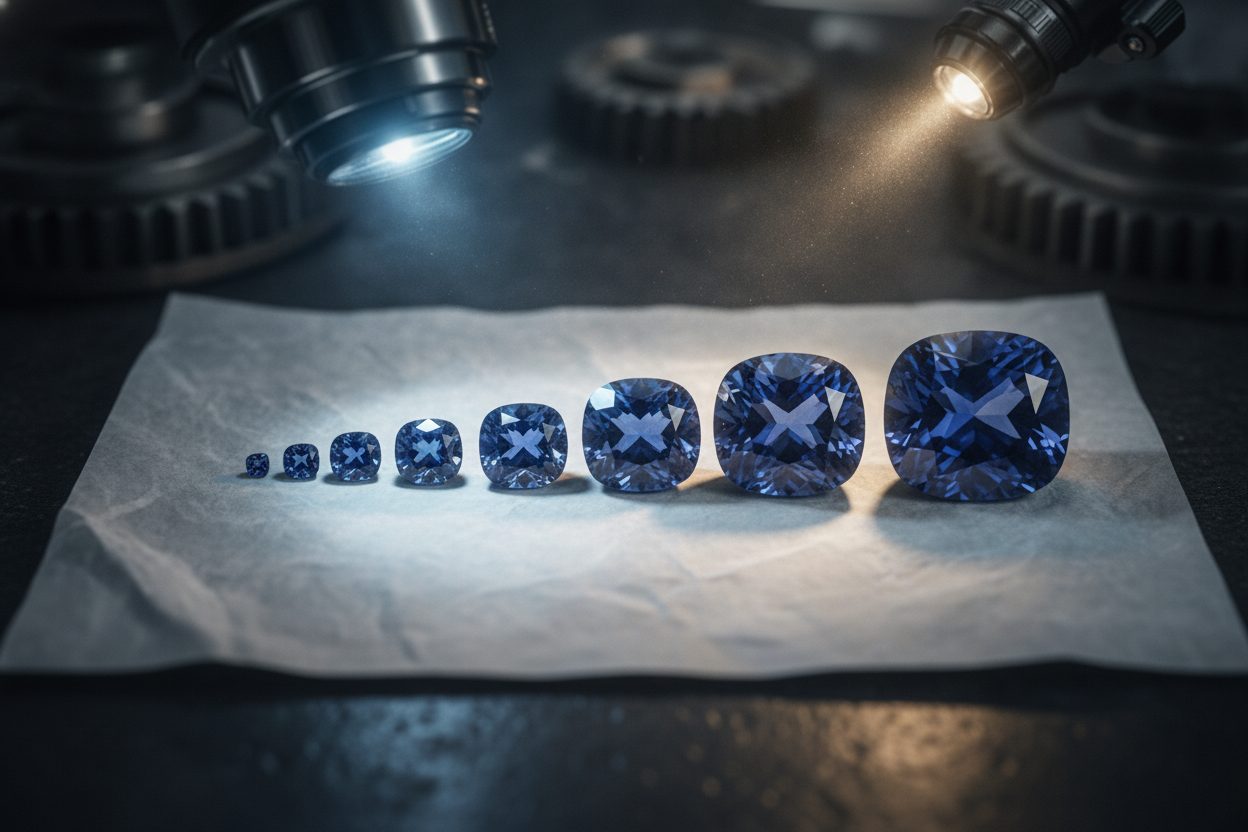
Price per carat is not linear with weight. It steps upward at the sizes where fine rough becomes scarce, so a larger stone of equal quality is worth more per carat, sometimes markedly so.
Quality behaves in tiers rather than a smooth gradient — commercial, good, fine, extra fine. The jump between two adjacent tiers usually exceeds the spread within a tier, which is why grading precision matters most near a boundary.
This is where automated colour data earns its place: it tells you which side of a boundary a stone sits on. It cannot tell you what the boundary is currently worth, because that is a market question answered by recent comparable sales.
What a fair range looks like
Build a range from comparables, not from a single asking price. Hold species, treatment status, size band, cut quality and laboratory constant, and only then compare colour grades — otherwise you are comparing different goods.
When machine learning gemstone grading appears in an offer, ask three things: what the system measured, whether the output is a measurement or a prediction, and which named laboratory or institution stands behind it.
If the answer cannot be reproduced or attributed, treat the grade as a seller's description and price accordingly. Sourced, repeatable data should reduce your uncertainty discount; an unverifiable score should not.
When an AI grade adds value
Instrumental consistency is most useful when you buy repeatedly, buy remotely, or assemble suites where stones must match. It also helps in re-cutting decisions, where proportion data predicts yield and appearance better than the eye alone.
For a significant purchase, it remains a supplement. Treatment disclosure and origin opinion from a recognised laboratory still carry the commercial weight, because those are the conclusions the trade prices against.
Algorithms are steadily improving the measurement layer of the market. The value layer — scarcity, taste and trust — is still set by people, and that is where your attention belongs.
Frequently asked questions
Does an AI grade replace a gemmological laboratory report?+
No. Automated systems measure colour, clarity and proportions consistently, but treatment disclosure and origin opinion still come from a recognised laboratory such as GIA, SSEF, Gübelin or AGL. Those conclusions are what the trade prices against.
Can machine learning determine a gemstone's origin?+
Only as an aid. Geochemical and inclusion data from different deposits overlap, so origin determination combines trace-element chemistry, microscopy and a specialist's reference experience. Models help narrow possibilities rather than issue final conclusions.
Will algorithmic grading make gemstones cheaper?+
It tends to sharpen prices rather than lower them. Better measurement reduces the uncertainty discount on well-described stones and exposes overgraded ones, so fine material often holds firm while loosely described goods lose their benefit of the doubt.
Can software detect heating or fracture filling?+
Spectral classifiers can flag stones that are likely treated and prioritise them for examination, which is how laboratories use them internally. Fine distinctions — low-temperature heating, or the degree of residue in an emerald — remain matters of expert interpretation.
Which value factor matters most for price per carat?+
For coloured stones, colour comes first: hue, saturation and tone together move price more than any other single attribute. Size, treatment status and origin then adjust that base, with clarity and cut refining it further.
Should I pay a premium for a stone with algorithmic colour data?+
Pay for what the data proves, not for the technology. Reproducible, attributable measurements justify confidence in a grade near a quality boundary; an unverifiable score from an unnamed system is simply a seller's description.
From our Journal
Buying guides, origin stories, and notes from the trade.