Sugilite: Meaning, Lore and Value
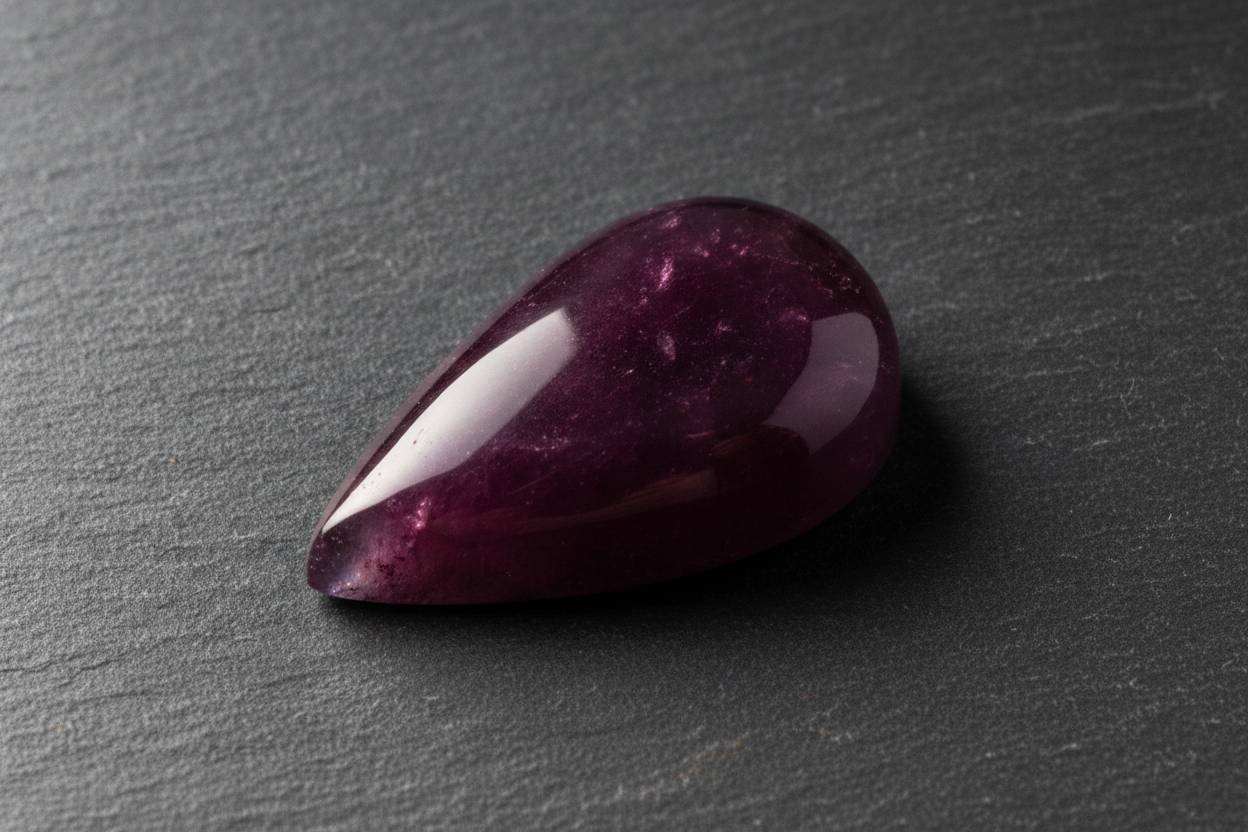
Sugilite meaning is almost entirely modern. The stone was first collected in Japan in 1944 and only formally described and named in 1976, so it carries no ancient scriptural or classical symbolism of its own; the associations now attached to it — spiritual protection, the crown chakra, emotional resilience — were assigned by crystal-healing authors in the 1980s, after gem-quality purple material emerged from South Africa's Kalahari manganese field. What sugilite genuinely inherits is older and broader: the long cultural association of deep purple with rank, priesthood and rarity. Gemmologically it is a hexagonal cyclosilicate coloured by manganese, Mohs 5.5 to 6.5, cut almost always as cabochon, and scarce in fine translucent grades.
Sugilite meaning in modern lore
Sugilite entered the metaphysical market late, and its reputation was built quickly. Writers in the 1980s crystal literature — most influentially Melody, author of Love Is in the Earth — promoted it as a stone of spiritual love and protection, and that framing has stuck.
Because the attributions are recent and traceable, they should be read as modern folklore rather than inherited tradition. That does not make them meaningless; it means their origin is documented rather than ancient.
In practice, buyers encounter three recurring themes: purple as a spiritual or regal colour, manganese purple as a symbol of transformation, and the stone's rarity as a metaphor for something hard-won. All three are cultural readings layered onto a mineral described within living memory.
Named for Ken-ichi Sugi
The mineral is named after the Japanese petrologist Ken-ichi Sugi, who collected the first specimens on Iwagi Islet, in Japan's Seto Inland Sea, in 1944. Those early finds were yellowish-brown and unremarkable, nothing like the saturated purple the trade now wants.
Formal description followed decades later, in 1976, which is why sugilite appears in no historical lapidary, no Vedic or Biblical gem list, and no European royal inventory. Its correct pronunciation follows the Japanese name — "soo-gee-lite", with a hard g — though "soo-jil-ite" has become common in the trade.
Dealers also marketed it under invented trade names, chiefly royal lavulite (or luvulite) and royal azel. These are commercial labels, not separate species, and a reputable seller will identify the stone as sugilite.
Purple, rank and symbolism
Sugilite's symbolic weight borrows from colour rather than from history. Deep purple was the most expensive dye in the Mediterranean world, restricted by sumptuary law in Rome and Byzantium, and it has signalled authority and consecration across many cultures since.
A fine sugilite cabochon reads as that colour in opaque, velvety form — closer to Tyrian purple than to amethyst's transparent violet. Charoite, purple jade and lepidolite occupy adjacent ground, but none has quite the same dense, unbroken saturation.
This is the honest basis for sugilite's symbolism: it participates in an old colour language, while the stone itself is new.
Healing claims, read honestly
Sugilite is widely sold as a healing stone, and it is worth being precise about what that means. The claims commonly made — pain relief, emotional shielding, support during illness — come from metaphysical publishing, not from clinical research, and no controlled evidence supports them.
We state that plainly because serious buyers deserve it. Many people wear sugilite for reasons that are personal, symbolic or devotional, and that is a legitimate reason to own a gemstone.
What we will not do is present folklore as medicine. A gem's documented identity and quality are verifiable; its meaning is yours to assign.
What sugilite actually is
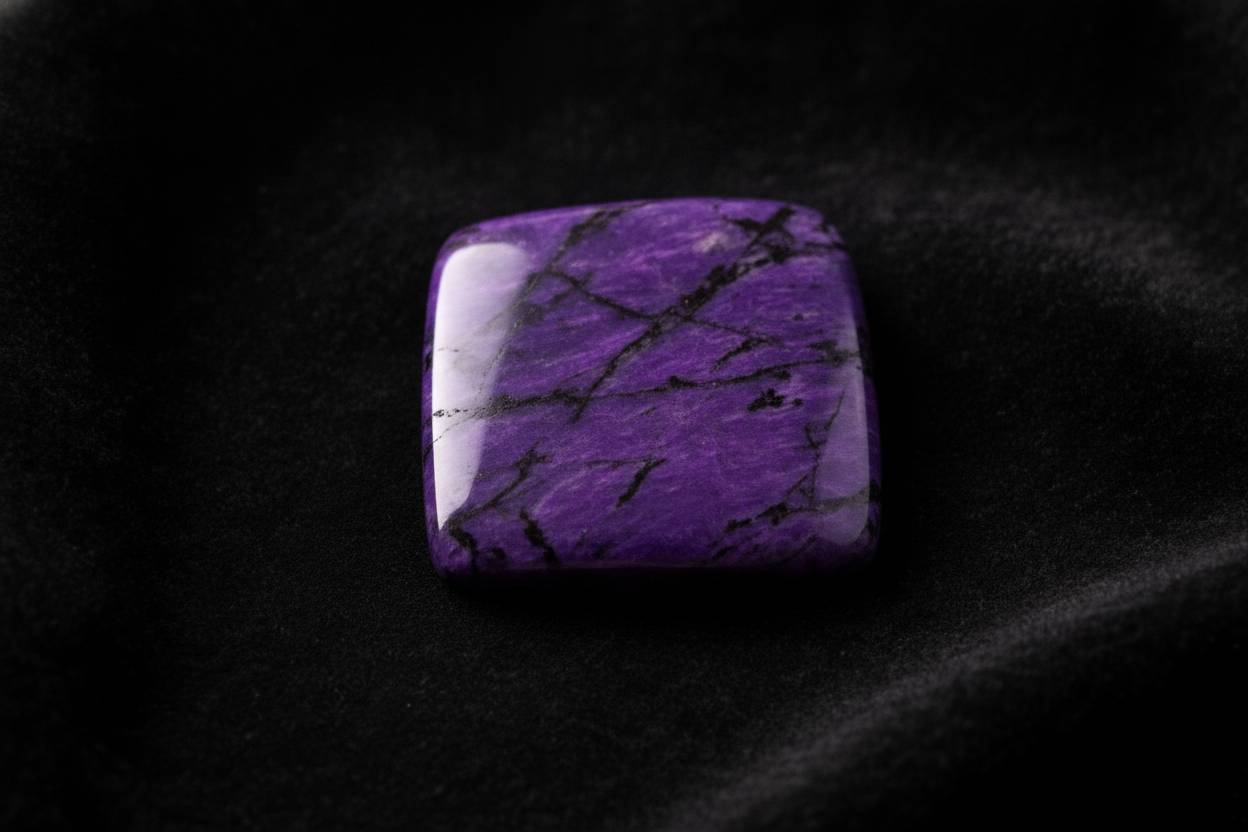
Sugilite is a complex potassium–sodium–lithium silicate of the osumilite group, crystallising in the hexagonal system. Its purple comes from manganese, which is why the finest material occurs in manganese-rich rock.
- Hardness: 5.5 to 6.5 on the Mohs scale — durable enough for pendants and earrings, vulnerable in daily-wear rings.
- Refractive index: approximately 1.607 to 1.610, usually read as a spot reading on a cabochon.
- Specific gravity: around 2.74 to 2.80.
- Transparency: opaque to translucent; the rare translucent grade is known as gel sugilite.
Colour ranges from pale lilac and greyish mauve through rich reddish purple to near-black violet. Massive material often shows black manganese oxide veining and patches of associated minerals, which some buyers value as character and others avoid.
Wessels Mine and rarity
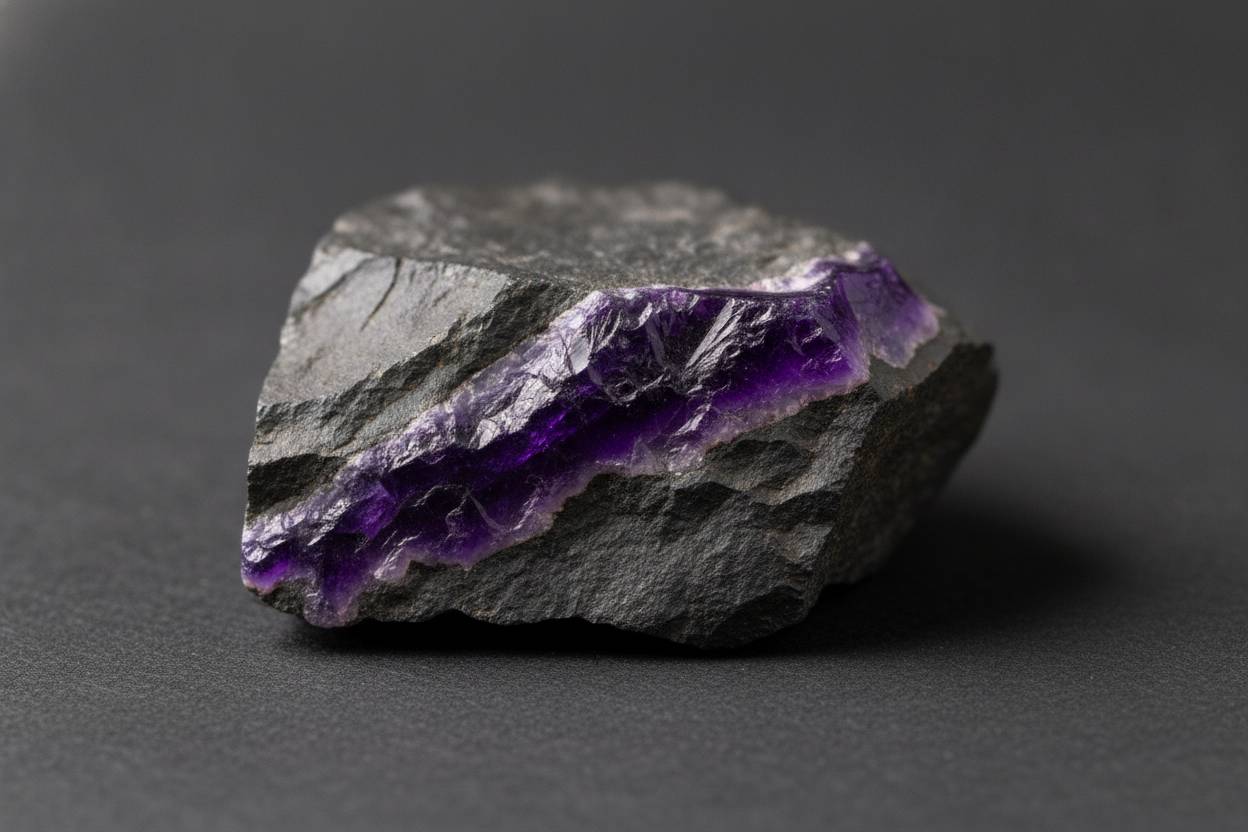
Virtually all gem-grade sugilite has come from the Wessels Mine in the Kalahari manganese field, Northern Cape, South Africa, where the purple material was encountered deep underground in the late 1970s. It is a manganese mine; sugilite is a by-product, not the objective.
Minor occurrences are recorded in Japan, at Mont Saint-Hilaire in Quebec, in Italy, India and Australia, but these have produced little or no cuttable purple material. That single-source dependence is the central fact of the sugilite market.
Supply is therefore tied to someone else's mining decisions, and fine translucent gel sugilite has become notably scarce. Older parcels cut in the 1980s and 1990s still circulate among collectors.
What drives sugilite value
Colour leads. Even, saturated reddish-purple without grey or brown modifiers sits at the top; pale, patchy or heavily veined material sits well below it.
Translucency is the second lever, and the gap between ordinary opaque sugilite and true gel material is wide. After that come evenness of colour across the cabochon, freedom from black oxide veining where a clean field is wanted, and size — large uniform pieces are far harder to find than small ones.
Sugilite is not routinely treated, though dyed or resin-stabilised imitations and plastic fakes exist. Ask whether the stone is natural, undyed and unstabilised, and buy from a seller who will put that in writing.
Sugilite rewards buyers who separate the two things it offers. One is a documented mineral with measurable properties and a single, finite source; the other is a young body of symbolism built on an old human instinct about the colour purple.
Frequently asked questions
What does sugilite symbolise?+
Modern crystal literature associates sugilite with spiritual protection, emotional resilience and the crown chakra, attributions that date from the 1980s rather than from ancient tradition. Its deeper symbolic weight comes from purple itself, a colour historically tied to rank, priesthood and rarity.
Where can I shop for sugilite, and what should I check?+
Buy from dealers who name the stone as sugilite rather than trade labels such as royal lavulite or royal azel, and who confirm in writing that it is natural, undyed and unstabilised. Ask for the colour grade, the degree of translucency, and whether the piece is Wessels Mine material.
Is sugilite rare?+
Gem-quality purple sugilite comes almost exclusively from the Wessels Mine in South Africa's Kalahari manganese field, where it is a by-product of manganese mining. Translucent gel sugilite in good size is genuinely scarce, and much of what circulates today is older stock.
Can sugilite be worn in a ring?+
It can, but with care. At 5.5 to 6.5 on the Mohs scale sugilite is softer than quartz and will abrade with daily knocks, so it suits pendants, earrings and occasional-wear rings better than an everyday band.
Does sugilite have proven healing properties?+
No. The healing properties attributed to sugilite come from metaphysical publishing, not from clinical research, and no controlled evidence supports them. Many owners wear it for personal or symbolic reasons, which is a different claim entirely.
How is sugilite identified?+
Sugilite is a hexagonal cyclosilicate with a spot refractive index of roughly 1.607 to 1.610 and a specific gravity near 2.74 to 2.80. A gemmological laboratory can separate it from dyed imitations, charoite and purple-dyed quartzite using these properties and spectroscopy.
From our Journal
Buying guides, origin stories, and notes from the trade.