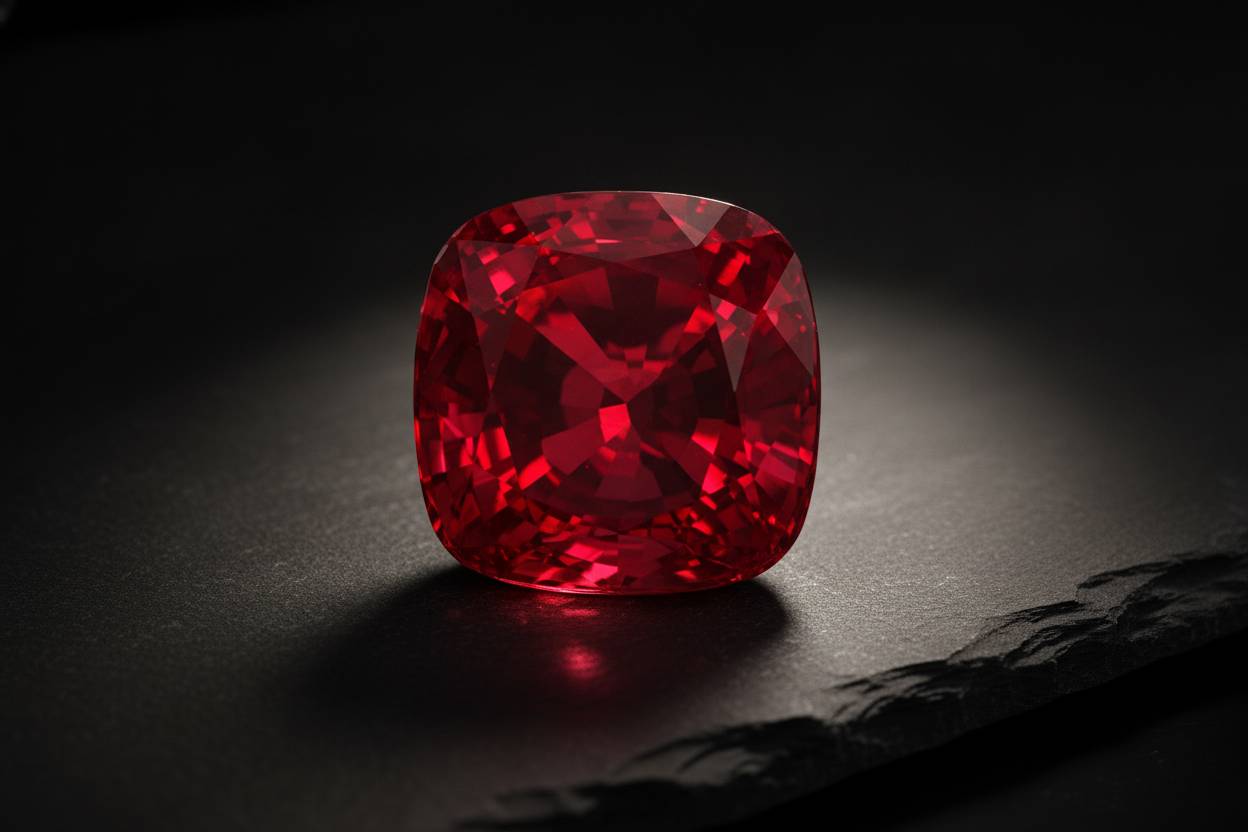
Estrela de Fura Ruby: Origin Story
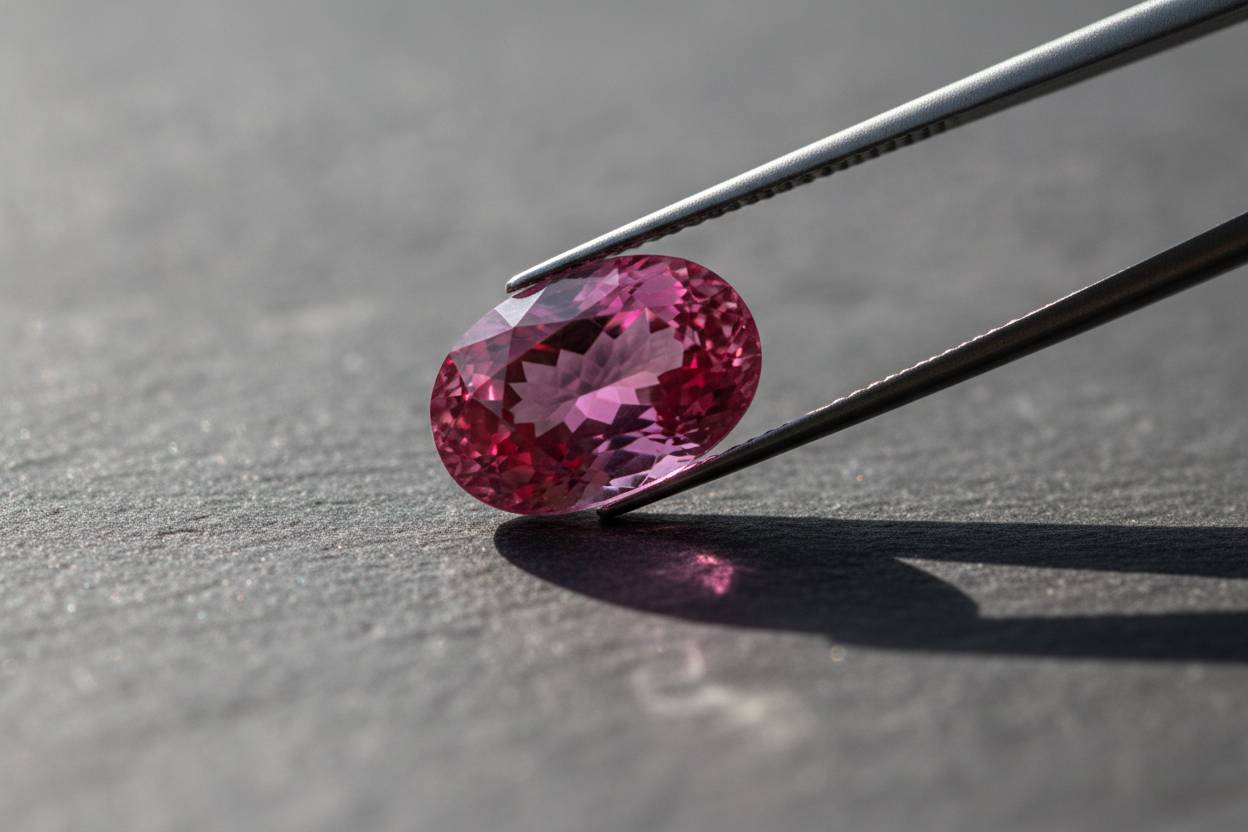
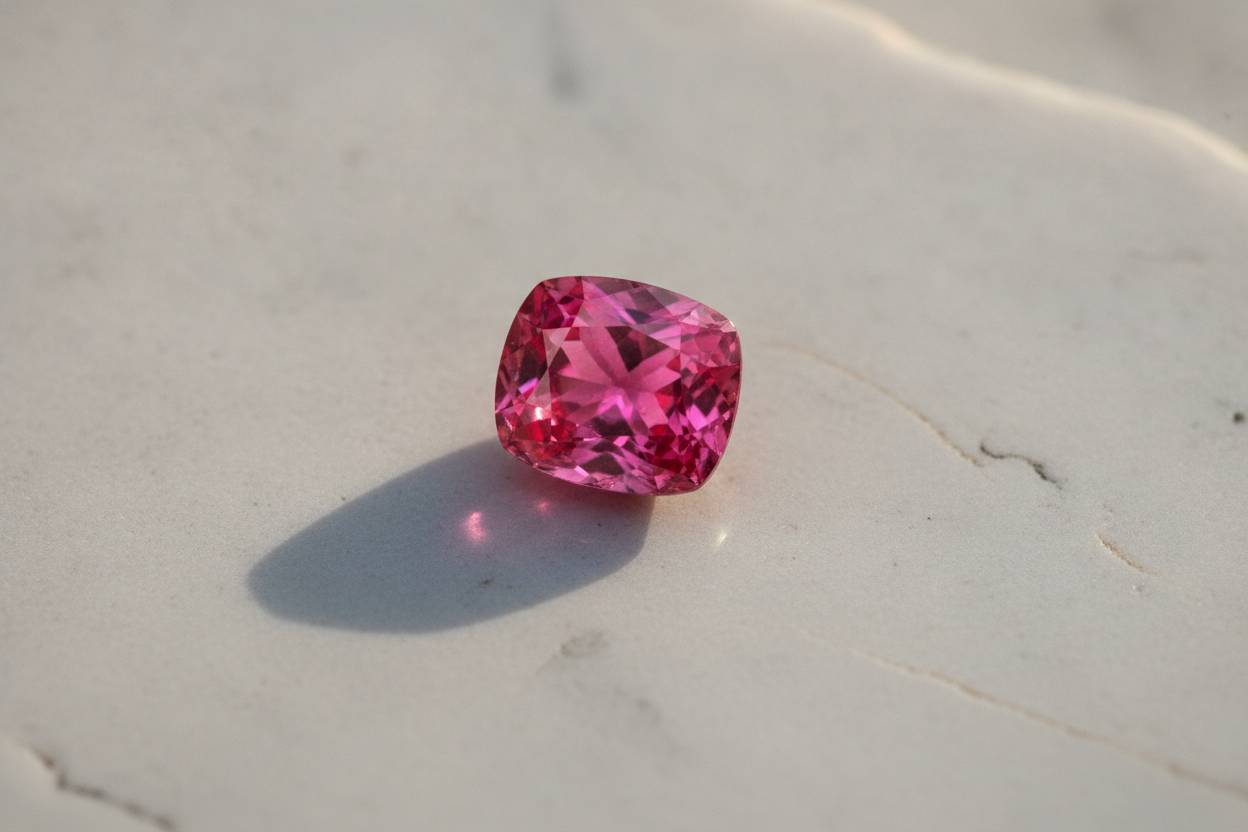
The Estrela de Fura ruby is a 55.22-carat cushion-cut ruby from Mozambique, cut from rough recovered in 2022 on Fura Gems' licence in the Montepuez area of Cabo Delgado province. Leading laboratories reported it as unheated, with a colour description in the pigeon's blood range, and its sale at Sotheby's in New York in 2023 set a world auction record for a ruby. Its real importance is provenance: it demonstrated that Mozambique — a source barely two decades old — can yield large untreated rubies at the very top of the quality scale, a position long assumed to belong to Burma alone.
Where the Estrela was found
Montepuez sits in northern Mozambique, inland from the Indian Ocean coast in Cabo Delgado. Commercial ruby discoveries there date only to around 2009, when artisanal diggers began working weathered gravels across a broad area of bush.
Within a few years the district had reshaped the global ruby supply, first through informal production and then through large-scale licensed mining. Fura Gems holds one of those licences; the rough that became the Estrela de Fura came out of its ground in mid-2022.
The stone's name translates as "Star of Fura," and the numerals appended in trade usage — 55.22 — record its finished weight. That weight, in untreated material of top colour, is the part that makes it exceptional rather than merely large.
Inside the Montepuez deposit
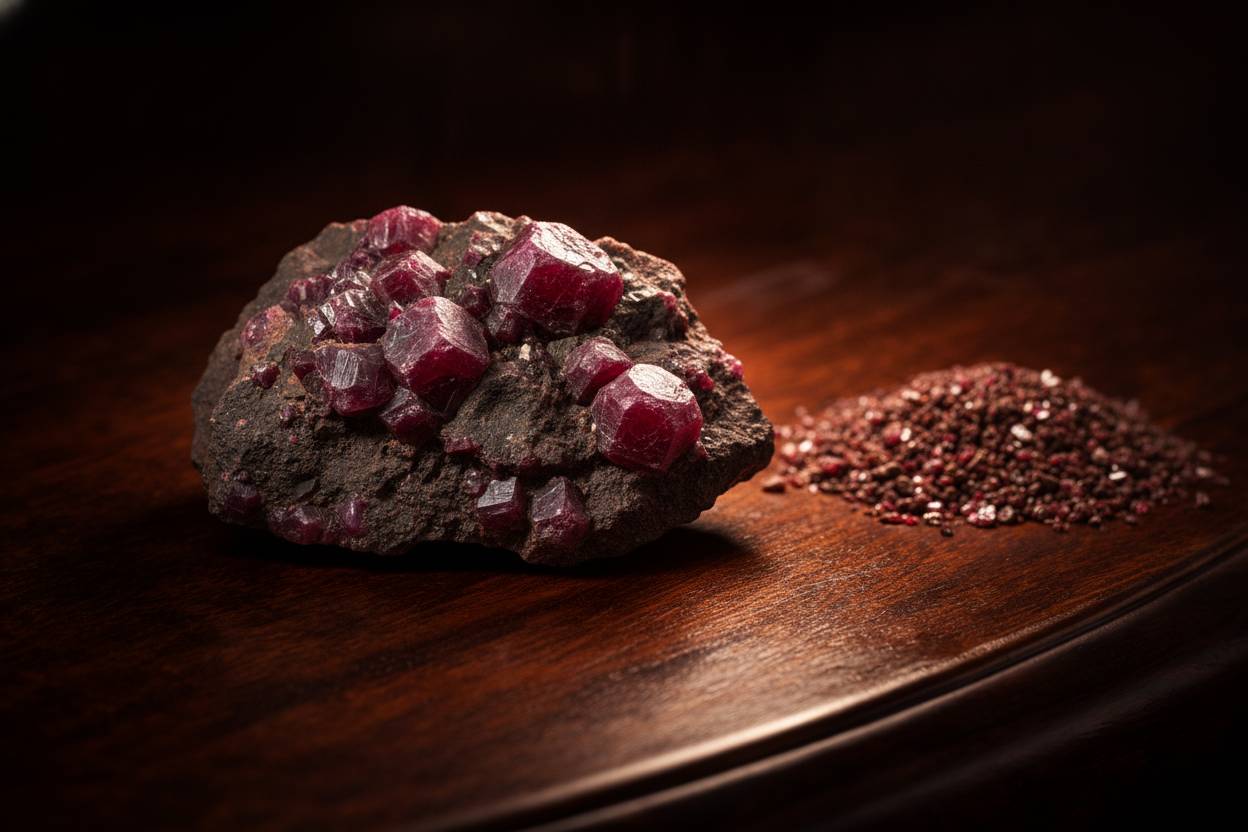
Montepuez rubies formed within the Mozambique Belt, a long band of metamorphic rock produced during the East African Orogeny as ancient continental blocks collided. The primary host is amphibolite, an iron- and chromium-bearing metamorphic rock, rather than the marble that hosts Burmese ruby.
Two broad types of material come out of the district: primary ruby still locked in or close to its host rock, and secondary ruby recovered from weathered gravels that have travelled and been naturally sorted. The secondary material is often cleaner and better shaped; the primary material can carry stronger colour and more distinctive inclusions.
Ruby is corundum — trigonal crystal system, Mohs 9, refractive index roughly 1.762 to 1.770, specific gravity near 4.00. Those constants are the same wherever the stone grew; the differences that matter commercially sit in trace chemistry and inclusion content.
Mozambique against Burma
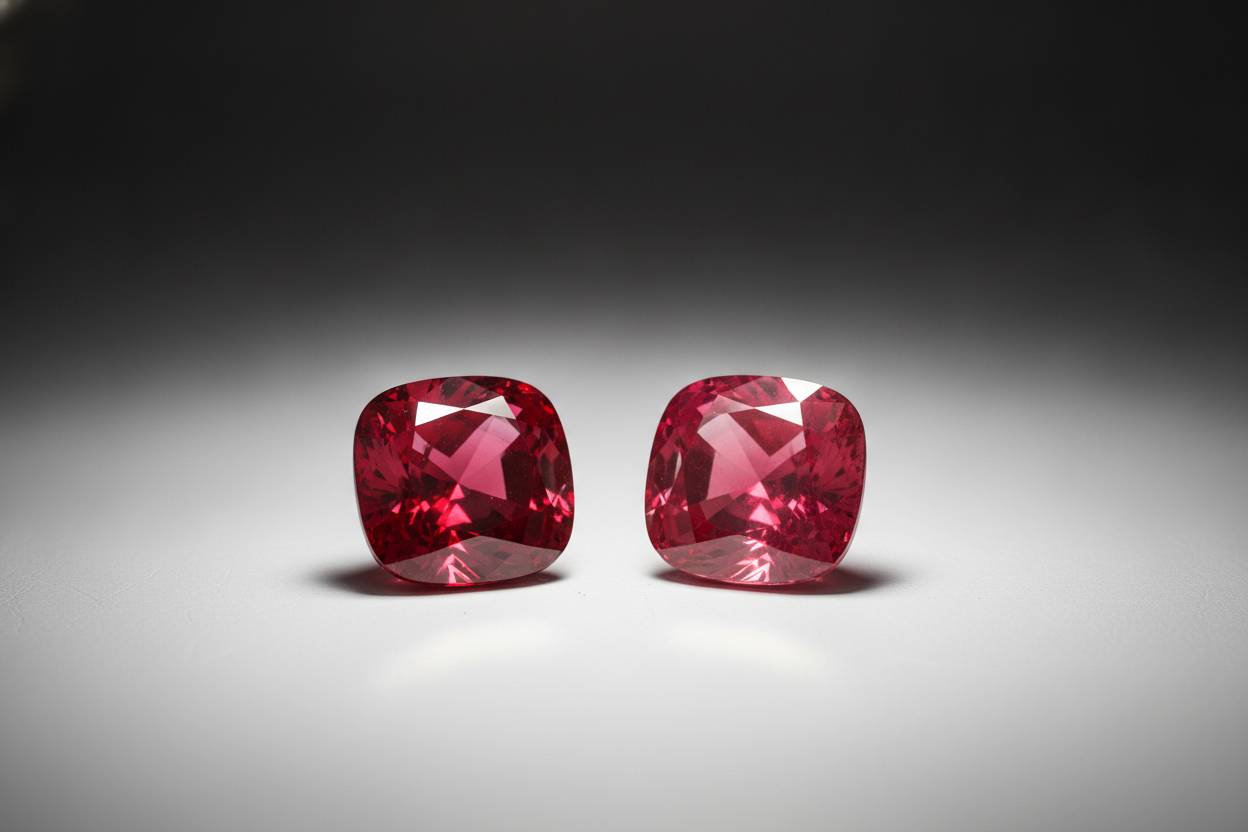
Marble-hosted Burmese ruby from Mogok is characteristically low in iron. Iron quenches fluorescence, so Mogok material tends to glow strongly under ultraviolet light and in daylight, giving the soft internal fire that built the Burmese reputation.
Amphibolite-hosted Mozambican ruby generally carries more iron, which can push colour towards a slightly darker, more purely red appearance with less fluorescent lift. The best Montepuez stones, however, overlap directly with fine Burmese material — strongly fluorescent, saturated, and clean.
Inclusion suites differ too. Mogok rubies commonly show fine intersecting rutile silk and calcite; Montepuez stones more often contain amphibole crystals, apatite, zircon with tension halos, and thin films or fingerprints along healed fractures.
Other sources worth knowing
- Mogok, Myanmar — the historic benchmark; small sizes dominate, and fine untreated stones above a few carats are genuinely scarce.
- Mong Hsu, Myanmar — abundant but almost always heated, with a blue core that heating removes.
- Thailand and Cambodia — basalt-related, high iron, darker reds; historically important, now largely depleted.
- Madagascar — both marble-hosted and amphibolite-hosted deposits, with material that can closely resemble Mozambican ruby.
- Tanzania, Kenya, Greenland, Tajikistan — smaller producers, occasionally superb, rarely consistent.
More from Ruby
Reading a ruby's birthplace
Origin is an expert opinion built from converging evidence, not a single measurement. A laboratory begins with microscopy, identifying the inclusion suite and any growth structures that point to a geological setting.
Chemistry follows. Laser ablation ICP-MS measures trace elements — iron, chromium, gallium, vanadium, titanium — and the ratios between them cluster differently for marble-hosted and amphibolite-hosted rubies. UV-Vis-NIR spectroscopy, FTIR, and photoluminescence add further constraints, including evidence of heat treatment.
Even then, deposits overlap, and some stones cannot be assigned confidently. Reports from SSEF, Gübelin, GIA, AGL and Lotus state origin as an opinion, and a careful buyer reads the treatment line with at least as much attention as the country name.
Why the record mattered
Before Montepuez, the top of the ruby market was effectively a Burmese monopoly, reinforced by scarcity and by sanctions that complicated trade in Burmese goods. Mozambique changed the supply picture, but the trade was slow to grant its stones equal standing.
The Estrela de Fura closed that gap in a single saleroom afternoon. A large, unheated, top-colour Mozambican ruby, fully documented, achieved a result that no ruby of any origin had reached at auction.
The practical consequence for buyers is that provenance alone no longer decides price at the summit. Colour, size, and the absence of treatment now carry the argument, with origin acting as a modifier rather than a verdict.
Buying with Mozambique in mind
Most Montepuez ruby on the market is heated, and heated material is priced accordingly. Untreated stones of good colour command a substantial premium, and that premium widens sharply as size increases.
Insist on a report from a recognised laboratory stating both treatment and origin. Be wary of heavily included, low-grade ruby treated with lead glass — it is a different product entirely, and it is not durable in the way corundum should be.
Judge the stone before the paperwork. Look at it in daylight and under warm light, check whether the red holds or goes flat and brown, and note whether the colour is evenly distributed across the face.
The Estrela de Fura ruby is a single extraordinary object, but the lesson it carries is general. Origin explains a great deal about how a ruby looks and how it was found — and almost nothing that a trained eye and a good laboratory report cannot verify for the stone in front of you.
Frequently asked questions
How big is the Estrela de Fura ruby?+
The finished stone weighs 55.22 carats and is a cushion cut. Its weight is the reason the numerals appear alongside the name in trade and auction references.
Where was the Estrela de Fura ruby mined?+
It was recovered in 2022 from Fura Gems' licence area in the Montepuez region of Cabo Delgado province, northern Mozambique. Montepuez has been a major ruby source since discoveries there around 2009.
Is the Estrela de Fura ruby heated?+
No. Leading laboratories reported it as unheated, which is a significant part of its value, since untreated rubies of large size and top colour are very scarce.
Are Mozambican rubies as good as Burmese rubies?+
The finest Montepuez stones overlap directly with fine Mogok material in colour and fluorescence. Burmese ruby is generally lower in iron and fluoresces more strongly, but origin alone no longer determines who sits at the top of the market.
How do laboratories determine ruby origin?+
They combine microscopic study of inclusions with trace-element chemistry measured by laser ablation ICP-MS, alongside UV-Vis-NIR, FTIR and photoluminescence spectroscopy. Origin is stated as an expert opinion, and some stones cannot be assigned with confidence.
Does a Mozambique origin report add value?+
It can, particularly for unheated stones of fine colour, because it confirms the material is natural corundum from a documented source. Treatment status usually affects price more than country of origin.
From our Journal
Buying guides, origin stories, and notes from the trade.