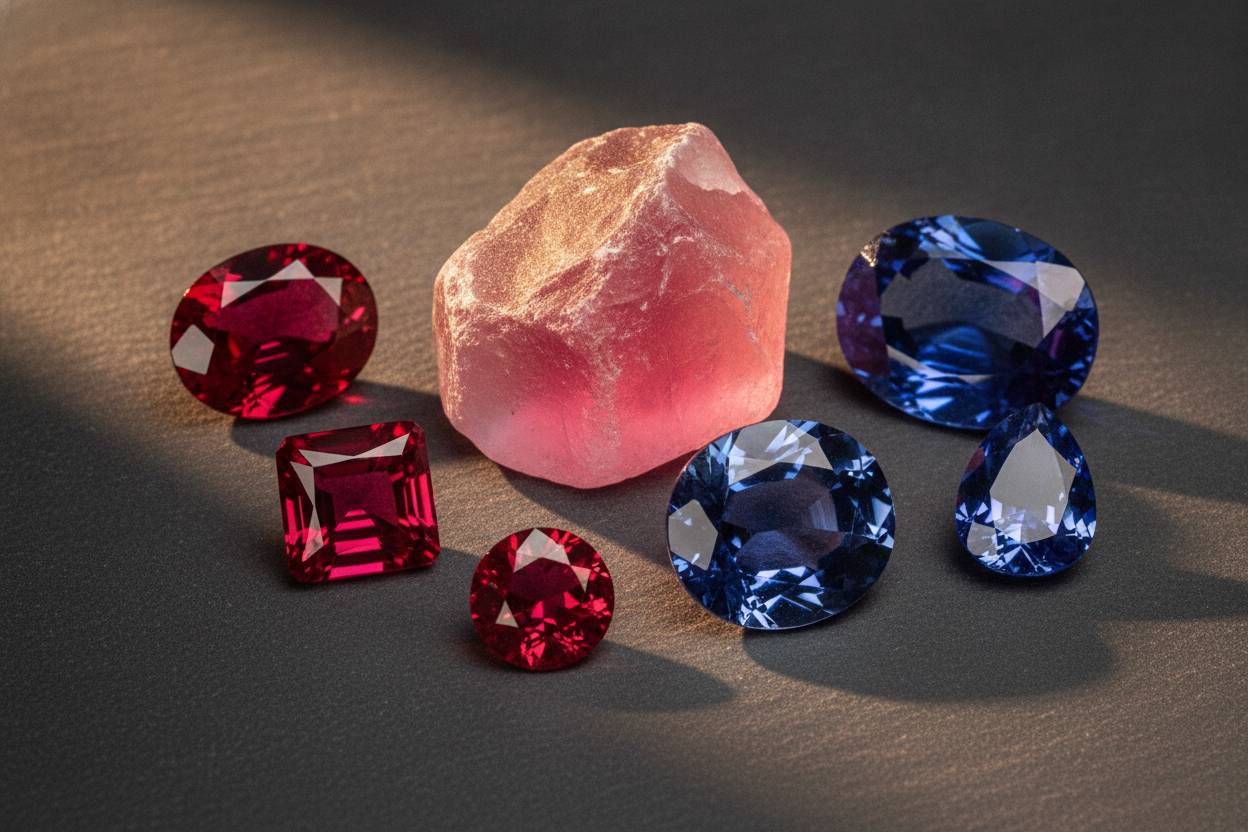
Synthetic Gemstone Trends, Explained
A synthetic gemstone is laboratory-crystallised material with the same chemistry, crystal structure and physical properties as its natural counterpart — synthetic ruby is corundum, not an imitation of it. Current synthetic gemstone trends are driven less by price and more by aesthetics: saturated, repeatable colour, matched suites, calibrated sizes, and forms that fine natural rough rarely supplies. The cultural reading has shifted with them. Where a made stone once implied deception, it now usually signals a deliberate design decision, provided the disclosure is plain and permanent.
That shift has a history behind it, and the history explains most of what buyers find confusing today.
Where synthetic gems began
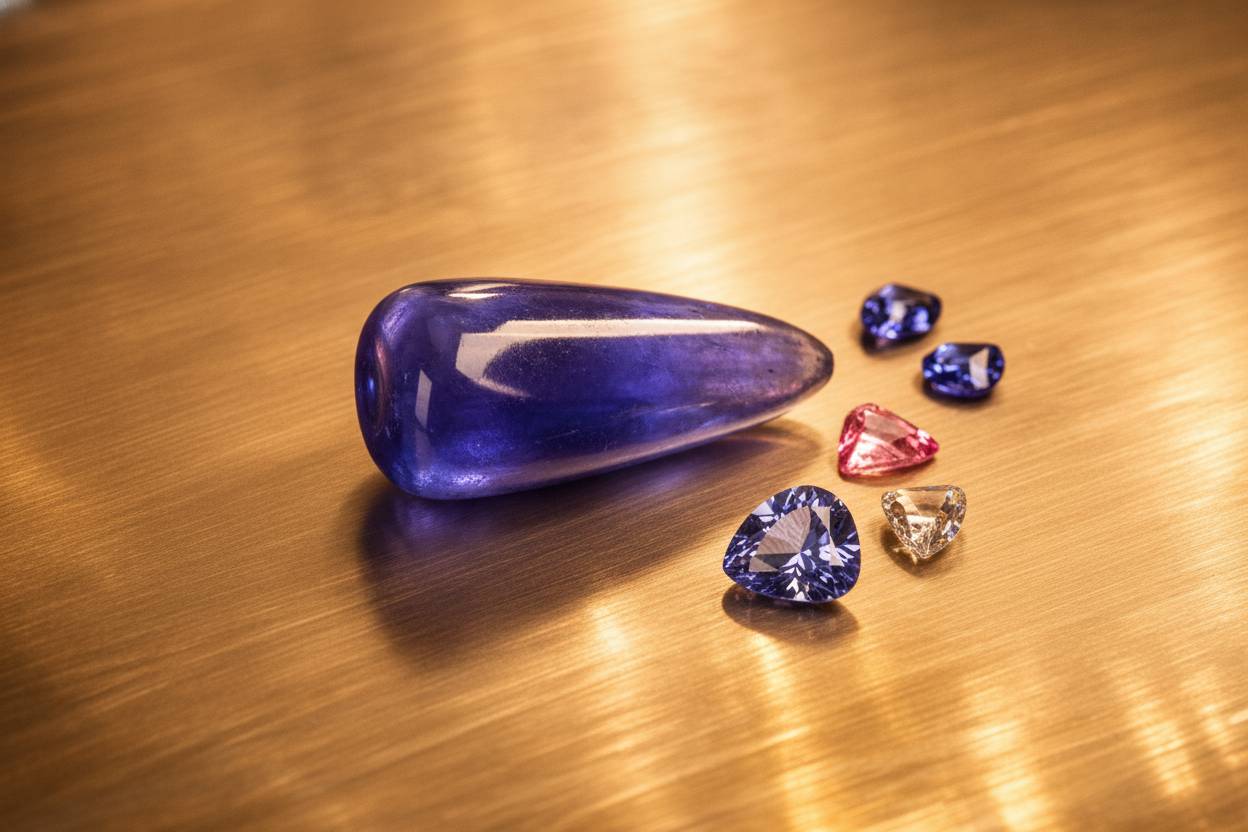
The first credible laboratory rubies are usually credited to the French chemist Marc Gaudin, who produced small corundum crystals in 1837. They were too small and too flawed to cut. The commercial breakthrough came from Auguste Verneuil, whose flame-fusion process was published in 1902 and remains the cheapest route to synthetic corundum and spinel.
Verneuil's method drops powdered alumina through an oxyhydrogen flame onto a rotating pedestal, building a carrot-shaped boule. Emerald resisted the technique, because beryl decomposes before it melts. Carroll Chatham grew the first commercially viable flux emeralds in the United States in the 1930s, and hydrothermal methods followed in Europe.
Other processes arrived through industry rather than jewellery. The Czochralski pulling method, developed in 1916, now grows optical-grade sapphire. General Electric announced the first reproducible laboratory diamonds in 1954; CVD growth for gem-quality material came decades later.
Synthetic, simulant, imitation
These three words are not interchangeable, and the difference is the single most useful thing a buyer can learn.
- Synthetic (also "laboratory-grown" or "created"): same species as the natural stone. Synthetic sapphire has the hardness of 9 on the Mohs scale, a refractive index near 1.762–1.770 and a specific gravity around 4.00 — the same constants as Ceylon sapphire, because it is the same mineral.
- Simulant: a different material that looks similar. Cubic zirconia is the classic case, with a refractive index around 2.15 and a specific gravity near 5.6–6.0 — values no natural diamond or sapphire approaches.
- Imitation: glass, plastic, doublets and assembled stones, which mimic appearance and nothing else.
Synthetic spinel and synthetic corundum have been sold as inexpensive "birthstones" since the 1920s, and much of the vintage jewellery trade still contains them. Recognising which category a stone falls into changes what it is worth and how it should be worn.
What synthetics meant culturally
Early twentieth-century jewellery absorbed synthetic corundum quickly. Calibré-cut synthetic sapphire and ruby suited the geometry of Art Deco design, where designers needed identical small stones in identical colour — something natural parcels deliver slowly and expensively.
Public sentiment was less generous. For most of the century a "made" stone carried a moral charge, associated with counterfeiting rather than craft, and trade bodies responded with disclosure rules rather than bans. The word synthetic itself became commercially awkward, which is why "laboratory-grown" now dominates marketing language.
The symbolism attached to gems has always been layered onto the material by people, not emitted by it. A sapphire's long association with constancy, or a ruby's with vitality, belongs to culture and text — to lapidaries, royal inventories and religious tradition — not to the crystal lattice. That is precisely why the meaning of a laboratory stone is contested: the lore travelled with the mineral, but the romance of scarcity did not.
Synthetic gemstone trends today
Contemporary synthetic gemstone trends cluster around three aesthetic goals. The first is colour consistency: line-ups of matched stones for eternity bands, tennis bracelets and pavé, where visible variation reads as a fault rather than as character.
The second is scale. Laboratory growth makes large, clean, strongly saturated stones ordinary, which suits maximalist design, cocktail rings and the bright colour palettes now favoured in fashion jewellery.
The third is disclosure as a feature rather than a confession. Designers increasingly name the growth method openly — hydrothermal emerald, flux ruby, CVD diamond — the way a maker might name a foundry. Natural stones, meanwhile, are increasingly sold on the opposite argument: geological origin, provenance and the record of a specific deposit.
How gemmologists tell them apart
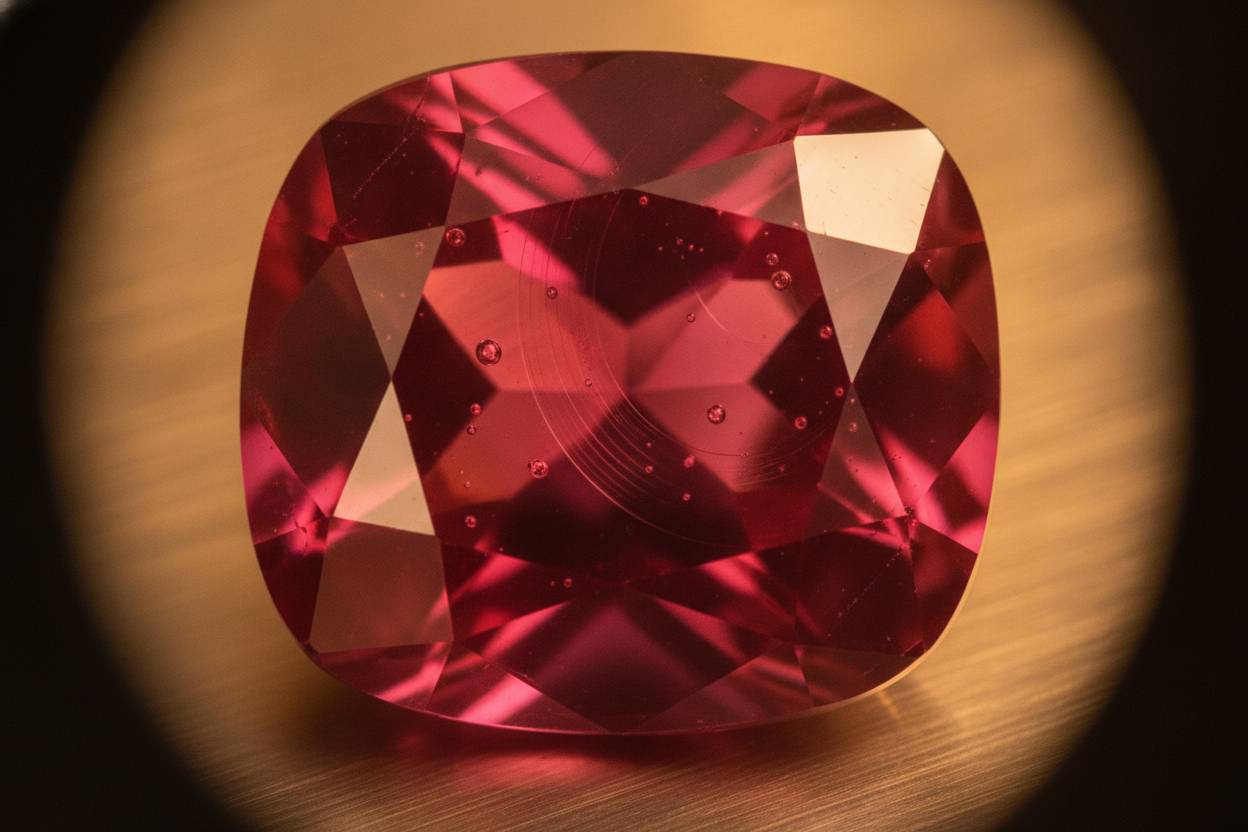
Separation is a laboratory matter, because refractive index and specific gravity are identical between a natural and a synthetic of the same species. The evidence lies in growth features and trace chemistry.
Microscope evidence
Flame-fusion corundum commonly shows curved growth striae and spherical gas bubbles — neither occurs in nature, where growth zoning follows straight, angular crystal faces. Flux-grown stones may retain wispy flux fingerprints or metallic platelets from the crucible. Hydrothermal synthetics often show chevron or nail-head growth patterns.
Spectroscopy and reports
Where inclusions are absent or ambiguous, laboratories rely on FTIR and UV-Vis-NIR spectra, photoluminescence and trace-element analysis. Reports from GIA, SSEF, Gübelin, GRS and AGL all state origin of growth as a matter of course. A stone without such a report, offered as natural at a natural-stone price, is an unverified claim.
What disclosure should state
Under the US Federal Trade Commission's jewellery guides and the CIBJO Blue Books, laboratory-grown material must be described with a clear qualifier — "synthetic", "laboratory-grown", "laboratory-created" or the maker's name — immediately adjacent to the gem name.
Ask for that wording on the invoice, not only in conversation. Ask which growth method was used, and whether the stone has been treated afterwards, since synthetics can be heated or diffused exactly as natural stones are.
A well-grown synthetic is a legitimate material with real optical merit and genuine design uses. It simply answers a different question than a natural stone does, and the price, the paperwork and the expectations should all reflect that.
Frequently asked questions
Is a synthetic gemstone the same as a fake?+
No. A synthetic has the same chemical composition, crystal structure and physical properties as the natural gem of that species, so synthetic sapphire is genuine corundum. A fake, or simulant, is a different material such as cubic zirconia or glass that only resembles the gem visually.
Can a jeweller tell a synthetic from a natural stone by eye?+
Rarely with certainty. Curved striae or gas bubbles in flame-fusion corundum can be seen under magnification by a trained gemmologist, but many modern synthetics are clean and require spectroscopy. For anything of value, rely on a report from a recognised laboratory.
Do synthetic gemstones hold value?+
They are priced as manufactured goods, not scarce natural resources, and supply can be increased at will. Expect them to behave like a design material rather than a store of value; the resale market for laboratory stones is thin compared with fine natural gems.
How must a synthetic stone be described when it is sold?+
The FTC jewellery guides and the CIBJO Blue Books require a clear qualifier such as synthetic, laboratory-grown, laboratory-created or the producer's name, placed directly with the gem name. That wording should appear on the invoice, not just in discussion.
Are synthetic gemstones ever treated?+
Yes. Laboratory-grown material can be heated, fracture-filled or diffused in the same ways natural stones are, and growth origin does not guarantee an untreated stone. Ask specifically about post-growth treatment as well as growth method.
Does a synthetic stone carry the same symbolism as a natural one?+
The traditional meanings attached to gems come from culture, texts and history rather than from the crystal itself, so a synthetic of the same species shares the mineral but not the record of a specific deposit or age. Many buyers value that geological history; others prioritise colour and design.
From our Journal
Buying guides, origin stories, and notes from the trade.