Onyx vs Black Diamond: What to Buy
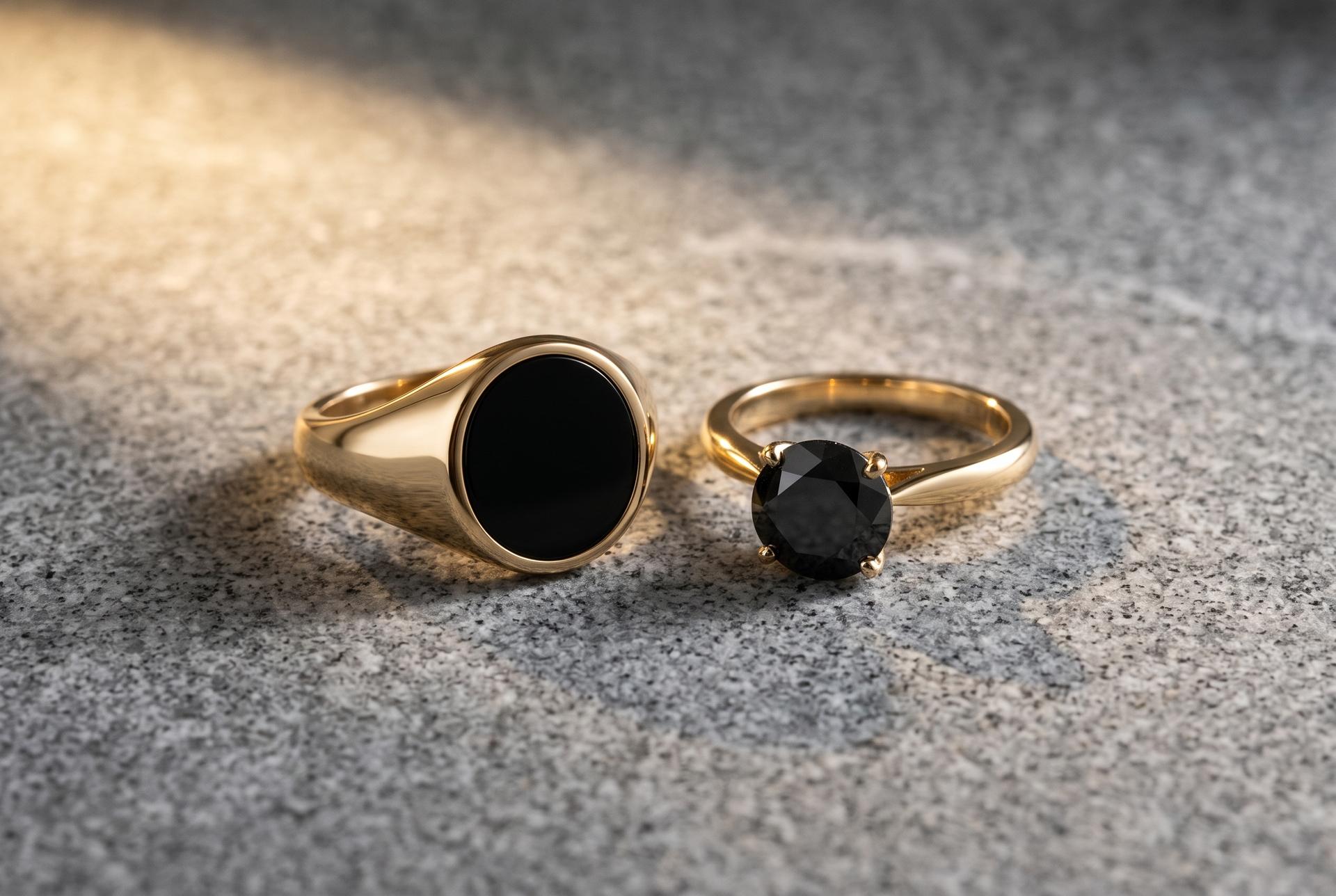
Black onyx and black diamond are the two stones driving the onyx jewelry trend, and they are separated in seconds by luster and weight: black diamond has a bright, mirror-hard surface and sits noticeably heavy in the hand, while onyx has a smooth, slightly waxy polish and feels light and warm. Onyx is dyed chalcedony — a quartz, Mohs 6.5–7 — and is priced modestly, with most of a piece's cost sitting in the metal and the cutting. Black diamond is a genuine diamond at Mohs 10 and costs far more, but is often heavily included or treated, which makes it brittle at the edges. Choose onyx for broad, graphic surfaces and signet work; choose black diamond for small, high-glitter accents.
Two very different blacks
Onyx belongs to the chalcedony family: cryptocrystalline quartz, trigonal, with a refractive index near 1.53–1.54 and a specific gravity around 2.60. Its blackness is uniform and light-absorbing, which is why it reads as a solid shape rather than a sparkling point.
Black diamond is cubic carbon, refractive index 2.42, specific gravity about 3.52. Its colour comes from dense graphite and sulphide inclusions, micro-fractures, or from treatment — not from a body colour in the usual sense.
That difference in origin decides everything else. Onyx is an even, opaque field of colour. Black diamond is a transparent mineral so crowded with inclusions that light cannot pass, leaving only surface reflection.
Two other stones enter the same conversation. Black spinel is naturally black, untreated, cubic, Mohs 8, with a specific gravity near 3.6 — a quiet, honest alternative. Obsidian is volcanic glass, softer at roughly 5–5.5, and chips far more readily.
Tests that separate them
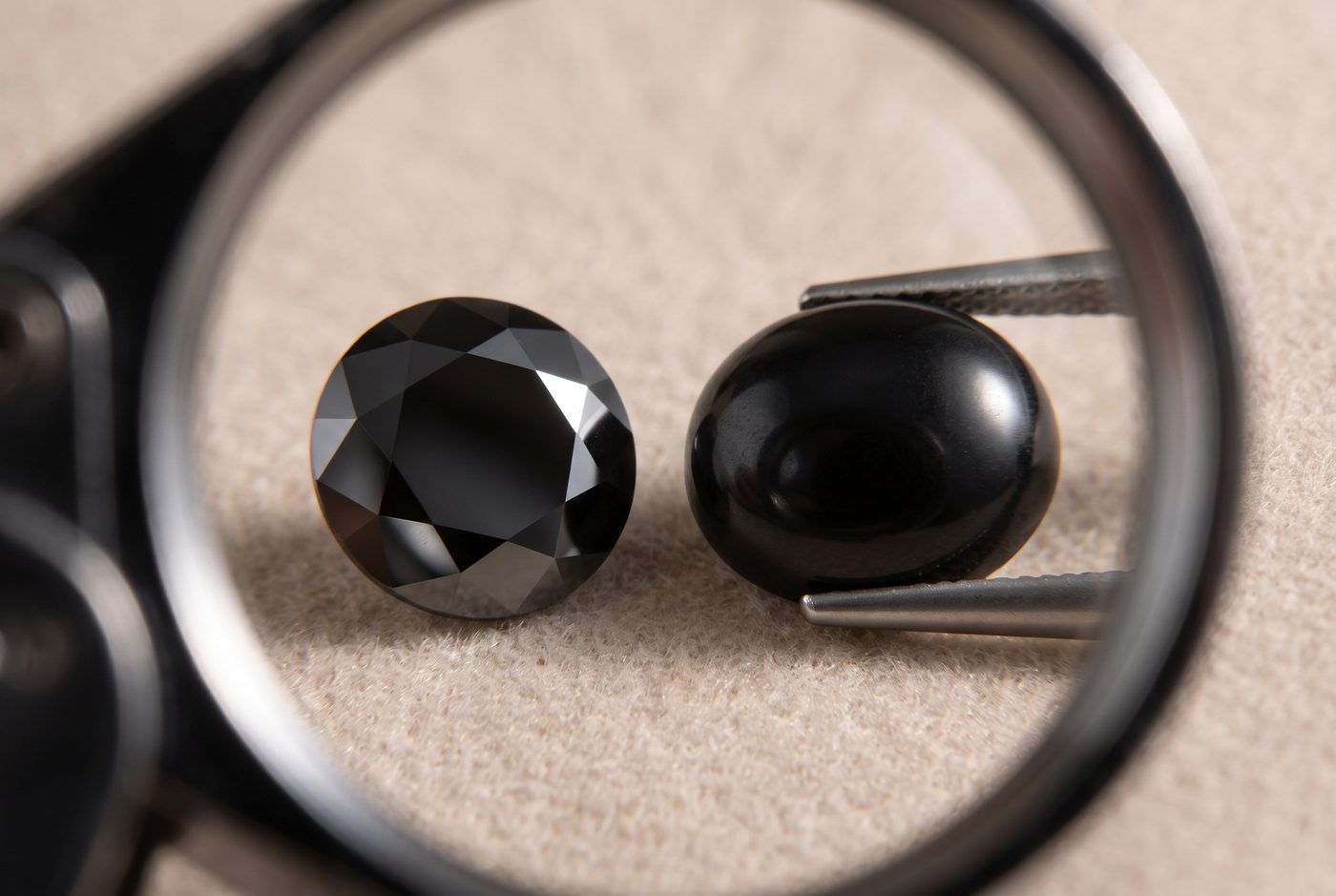
Luster is the fastest separator in daylight. A polished black diamond shows adamantine, almost metallic reflections, usually with visible surface pitting and naturals where inclusions reach the facet. Onyx gives a smooth vitreous-to-waxy sheen with no pitting.
Weight is the second check. Lift a loose stone of known size: diamond and spinel feel dense, onyx feels distinctly light for its volume.
Thermal behaviour helps too. Diamond is an exceptional heat conductor and feels cold against the lip or cheek; onyx warms quickly to skin temperature. A standard thermal diamond tester will separate the two without ambiguity.
Under the loupe
- Black diamond: open fractures, graphite clouds, a slightly uneven polish that follows hardness directions in the crystal.
- Black onyx: a featureless, glassy field; occasionally faint banding, or dye concentrated along a hairline if the dyeing was poorly done.
- Black spinel: clean, glassy, single refractive, with better polish than onyx and no adamantine fire.
- Obsidian: conchoidal, shell-like fracture at the edges; sometimes gas bubbles or a bronze-grey sheen.
Dye, heat and disclosure
Nearly all black onyx on the market is grey or banded chalcedony dyed black, traditionally by soaking in a sugar solution and then carbonising it with acid. The result is permanent, stable, and accepted trade practice — but it must be disclosed as dyed chalcedony.
Black diamond is frequently treated as well. Irradiation or high-temperature annealing turns heavily included brownish or greenish diamond opaque black, and treated material should be identified as such on any report.
So neither stone is automatically "natural" in the way buyers assume. The reasonable question is not whether the colour was assisted, but whether the seller says so in writing. The GIA, SSEF and the Gem-A syllabus all treat disclosure of dye and irradiation as standard.
More from Spinel
How each wears over time
Hardness favours diamond overwhelmingly: Mohs 10 against onyx at 6.5–7. In practice the gap narrows, because black diamond's inclusion network makes it comparatively brittle and prone to chipping at the girdle or along an exposed edge.
Onyx does not cleave and has reasonable toughness for a quartz, but it will acquire fine scratches on a broad flat table over years of daily wear. On a signet ring worn every day, that surface eventually goes from glassy to softly matte.
The good news is that onyx can be repolished by a lapidary, which restores the original depth. Treat it gently: warm soapy water and a soft brush, never ultrasonic or steam, and keep it away from solvents and chlorine.
The onyx jewelry trend and cost
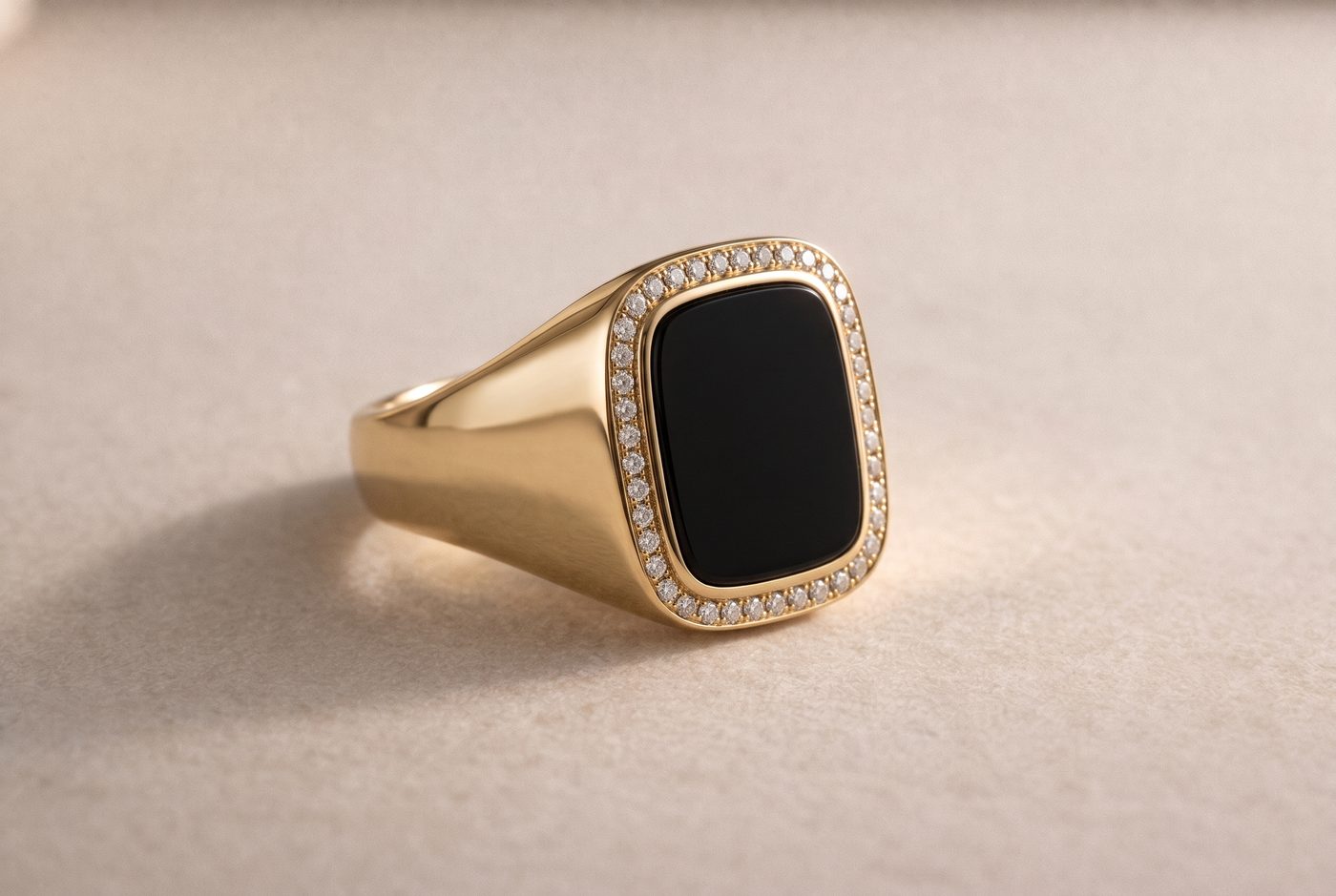
Onyx is inexpensive as a material. Price in a finished piece tracks the gold weight, the precision of the cutting, and how well the panels are matched in an inlay or a pair of earrings — not the carat count.
Black diamond sits far above it per carat, though well below colourless diamond of similar size. You are paying for the species, the hardness, and the adamantine reflection, which no quartz can imitate.
This is why the current appetite for black stones splits so cleanly. Onyx carries large, graphic volumes affordably — tablets, cabochons, carved intaglios, inlaid bands. Black diamond works where sparkle matters at small size, such as pavé outlines or a halo against yellow gold.
Choosing between the two
Choose onyx for scale and silhouette: signet rings, flat-topped cocktail rings, long drop earrings, cufflinks, and Art Deco–style contrast against diamond or white metal. It is also the sensible choice when a large black surface is wanted on a disciplined budget.
Choose black diamond for an everyday solitaire or accent stone where hardness and glitter justify the premium. Ask whether the colour is natural or treated, and inspect the girdle for chips before buying.
Consider black spinel as a middle path. It is naturally black, routinely untreated, harder than onyx, and takes a crisper polish — useful for faceted beads and small faceted accents where onyx would look flat.
Both stones are legitimate. The mistake is paying diamond money for a stone that behaves like onyx, or expecting onyx to sparkle like a diamond across a room.
Frequently asked questions
Is black onyx always dyed?+
Almost all commercial black onyx is grey or banded chalcedony dyed black using a sugar-and-acid carbonising process. The colour is permanent and stable, but reputable sellers disclose it as dyed chalcedony.
How can I tell onyx from black diamond at home?+
Compare lustre and weight: black diamond shows bright, almost metallic reflections and feels dense, while onyx has a smoother, waxier sheen and feels light. A thermal diamond tester will confirm the difference in seconds.
Is onyx durable enough for an everyday ring?+
Onyx sits at Mohs 6.5–7 with no cleavage, so it resists breaking but will accumulate fine surface scratches with daily wear. A bezel or flush signet setting protects the edges, and a lapidary can repolish the surface later.
Is black spinel better than onyx?+
Black spinel is harder at Mohs 8, naturally black without dye, and takes a crisper polish, which suits faceted beads and small accents. Onyx remains the better choice for large flat panels, carving and inlay.
Why are black diamonds so much cheaper than white diamonds?+
Black diamonds are typically heavily included or fractured material that would otherwise be low grade, and many are irradiated or annealed to produce the colour. They still cost far more per carat than onyx because they are genuine diamond at Mohs 10.
How should I clean onyx jewellery?+
Use warm water, mild soap and a soft brush, then dry with a lint-free cloth. Avoid ultrasonic and steam cleaners, chlorine, and solvents, all of which can damage dyed chalcedony or loosen the setting.
From our Journal
Buying guides, origin stories, and notes from the trade.